Jubilee spring with Mahler’s Second
The cover story – 2025 in Helsinki
Mahler Symphonies are relatively often – and well – played in Helsinki. The Finnish Radio Symphony Orchestra (RSO) played a full cycle of the symphonies during the season 2018-2019. The Chief Conductor and Artistic Director of Helsinki Philharmonic Orchestra, Jukka-Pekka Saraste seems to have adopted a habit of closing the season with Mahler in big: May 2024 with the eight and May 2025 with the second. Now we are looking forward to the third in 27th & 28th of May 2026 (tickets from 2.12.2025 09:00, GMT+2). Nowadays, HPO concerts bear subtitles, and for the M3 they have invented: “Great, Greater, Mahler” – not a bad idea.
But I was to write on the ‘Jubilee spring 2025 with Mahler’. This was not part of the ‘Annum jubileum 2025’. Could it have been? Anyway, I’m ready to defend the term ‘Jubilee spring with Mahler’. The Mahler’s second is often played to celebrate significant events. Now it was played four times with three orchestras in the Helsinki Music Centre: twice by RSO, once by HPO and the Sibelius Academy Orchestra and choirs (SIBA). Noting that the words of “Auferstehung” hymn (as edited by Mahler) can be understood as a wish for a new phase in life, and they are playing it for four times in the days of my retirement, … Yes, it got personal. Even more, as my colleagues responded without hesitation and positively when I suggested M2 being played in my retirement party (which then had to be scheduled for Saturday afternoon and evening). Actually, it wasn’t all my idea. When the party was first discussed in our lunch table, Juho became joking, whether we need a symphony orchestra for it. He was right and he hit a nerve.
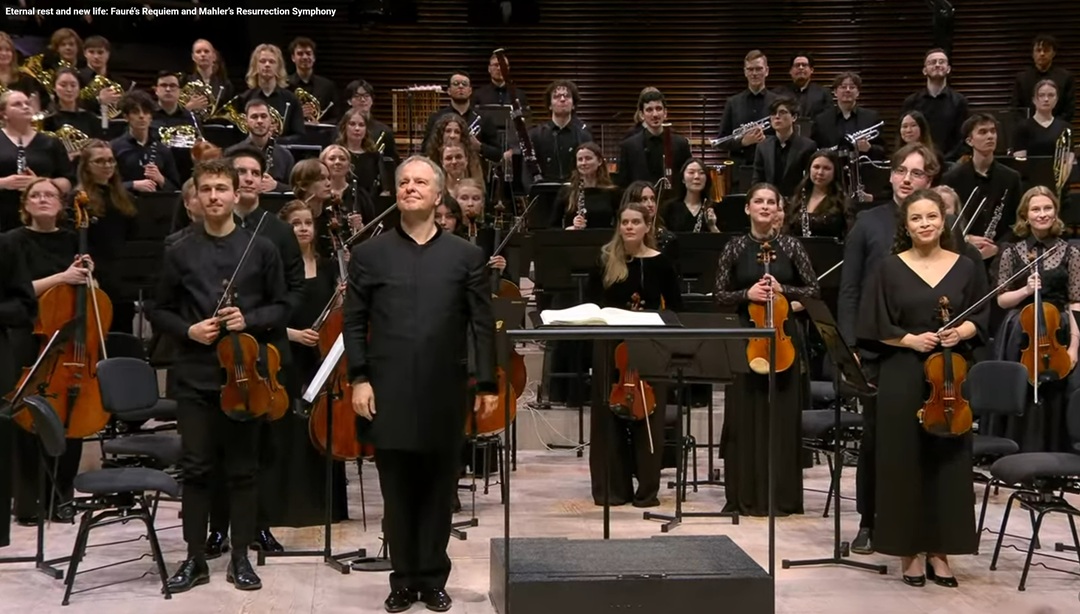
So the SIBA concert became a part of our party and a test for my hypothesis on Mahler’s ability to welcome new listeners in the symphony halls. We had a group of 25, a couple of regular concertgoers, but majority of the participants visited the Helsinki Music Centre and a symphony concert for the first time. I believe all were honest when expressing their experiences in positive terms, even though the program was ‘overloaded’ [#] to almost three hours: the Requiem by Gabriel Fauré together with the Mahler’s second. The hypothesis received good support: Mahler did not compose for professionals only, Q.E.D., or “VTT:n testaama!” – tested by VTT Technical Research Centre of Finland. The cover photo of this website was taken by Siddhart to remind us of the event.
But what was the concert about? The vocal powers for M2 were partially reinforced by singers in the Music Centre Chorus, but the players and soloists were students of the Sibelius Academy. Why collect such a wide group of students on the stage to play and sing such a complex and large piece of music as M2 and Fauré’s Requiem? The concert became an impressive demonstration of devotion and achievement in education of musicians in the Academy. Also a celebration at a moment of departure. We could hear and see what Sakari Oramo was able to do and achieve together with the students who evidently enjoyed being on this stage. So did Oramo. It was a real pleasure to see him communicating with the individual players and the huge group of students, who performed the symphony as experienced professionals. Sakari Oramo was not retiring, but completed his tenure as professor of orchestral training and conducting in the Sibelius Academy. He has acted as chief conductor of several orchestras (RSO, Birmingham, Stockholm, …), perhaps best known of his long growing post (2012-2030) in the BBC Symphony Orchestra.
[#] I wrote ‘overloaded’ thinking that it would be a common habit to play the ‘big pieces’, such as M2, M3, M8 alone. Maybe it is. However, I recall now that in May 2008 RSO & Sakari Oramo played M2 together with Arnold Schoenberg’s Chamber Symphony No. 2. Furthermore, as part of the 1985 London Mahler Festival “Mahler, Vienna and the twentieth century”, LSO & Claudio Abbado presented M2 together with the ‘neo-romantic’ DIS-KONTUR (1974) by Wolgang Rihm. (I’ll write later on the great Mahlerian Claudio Abbado and on the London festival, which addressed the Vienna Secession movement in parallel with Gustav Mahler – as a mirror view for the current “Gallen-Kallela, Klimt & Wien” exhibition in Helsinki Ateneum.)
Eternal rest and new life:
Faure’s Requiem and Mahler’s Resurrection Symphony
The recording of the concert is available at youtube:
The Requiem by Gabriel Fauré begins at 4 minutes
The Mahler’s Symphony Nr. 2 at 78 minutes
The performers for : Gabriel Fauré: Requiem
Jani Sivén, conductor Sini Wallius, organ
Manca Kumar, soprano Gabriel Kivivuori Sereno, baritone
Sibelius Academy Choir Jani Sivén, choir coach
S. A. Kuopio Unit Chamber Choir Saara Aittakumpu, choir coach
The performers for : Gustav Mahler: 2. Symphony
Sakari Oramo, conductor Jani Sivén, choir master
Hannele Ahola, soprano Marion Jegou, mezzosoprano
Sibelius Academy Choir Jani Sivén, choir coach
S. A. Kuopio Unit Chamber Choir Saara Aittakumpu, choir coach
Helsinki Music Centre Chorus Nils Schweckendiek, choir coach
Sibelius A. Symphony Orchestra Kyösti Vesterinen, assistant conductor