Mahler is back in Town – with Vienna Secession, Klimt, Gallen-Kallela
The Finnish National Gallery ‘Ateneum’ hosts a broad exhibition focusing on arts and crafts related to the “Vienna Secession” movement. This group of revolutionary artists, architects and craftsmen aimed to reform, broaden and unite arts in a broad sense. The “Vienna Secession” movement was founded in 1897 and experienced its most cohesive period during Mahler’s tenure in the Hofoper. Mahler had met the founding members of the Secession and in this connection also his wife Alma Maria Schindler.
“Mahler is back in Town” – in Helsinki, but how? Actually, in two different ways, from Mänttä in form of a famous portrait and from Vienna as a symbolic hero of the united arts.
Axel Gallén and Gustav Mahler
One of the key ideas of the “Vienna Secession” movement was to establish permanent contacts between the artists in Vienna and the avant-garde abroad. Already the first exhibition at the Horticultural Halls in spring 1898 displayed sculptures by Auguste Rodin and paintings by eleven guest painters together with the Vienna secessionists. Axel Gallén, a prominent Finnish painter joined the international network of Vienna Secession and contributed to the Vienna Secession exhibitions of 1901/02 and 1904. This explains why Gallén became acquainted also with Mahler. Thus, when visiting Helsinki in 1907, Gallén [#] was one of Mahler’s key hosts.
[#] At the time Axel Gallén had adopted a new name referring to Finnishness:
Akseli Gallen-Kallela, but for Gustav and Alma Mahler he remained Axel Gallén,
as he appears in Mahler’s long letters from Helsinki.
In a chilly morning of November 2nd, 1907, following the Helsinki concert, Gallén picked Mahler from the Hotel Societetshuset (current Helsinki city hall by the Marketplace) for an extreme experience: a three hour long boat ride to Espoo and further to Hvitträsk in a horse-drawn carriage. Mahler was freezing, but wrote to Alma very pleased with this exciting experience. He was impressed of ‘how wonderfully Gallén had organized him the trip (like a hare hunter)’ and the hospitality by architects Eliel Saarinen and Herman Gesellius at Hvitträsk in their forest studio and mansion “– ganz a la Hohewarte in’s Finnische übersetzt”, i.e., Jugend style, just as at home in Vienna.
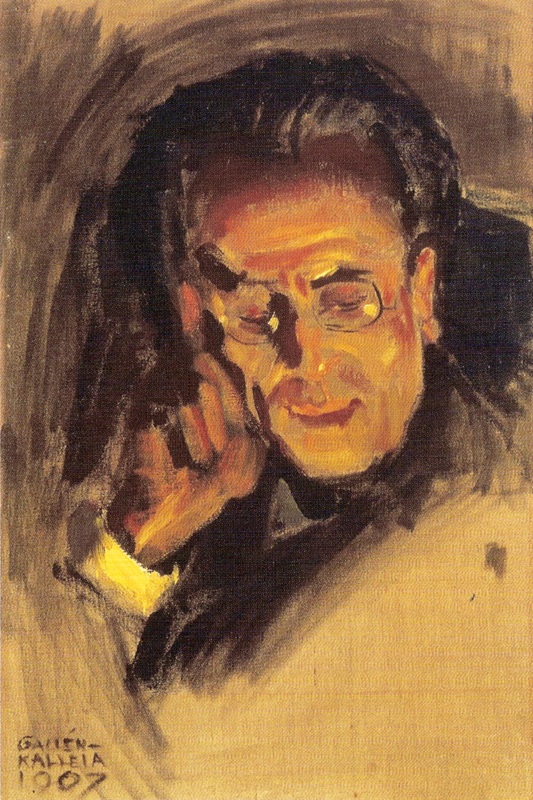
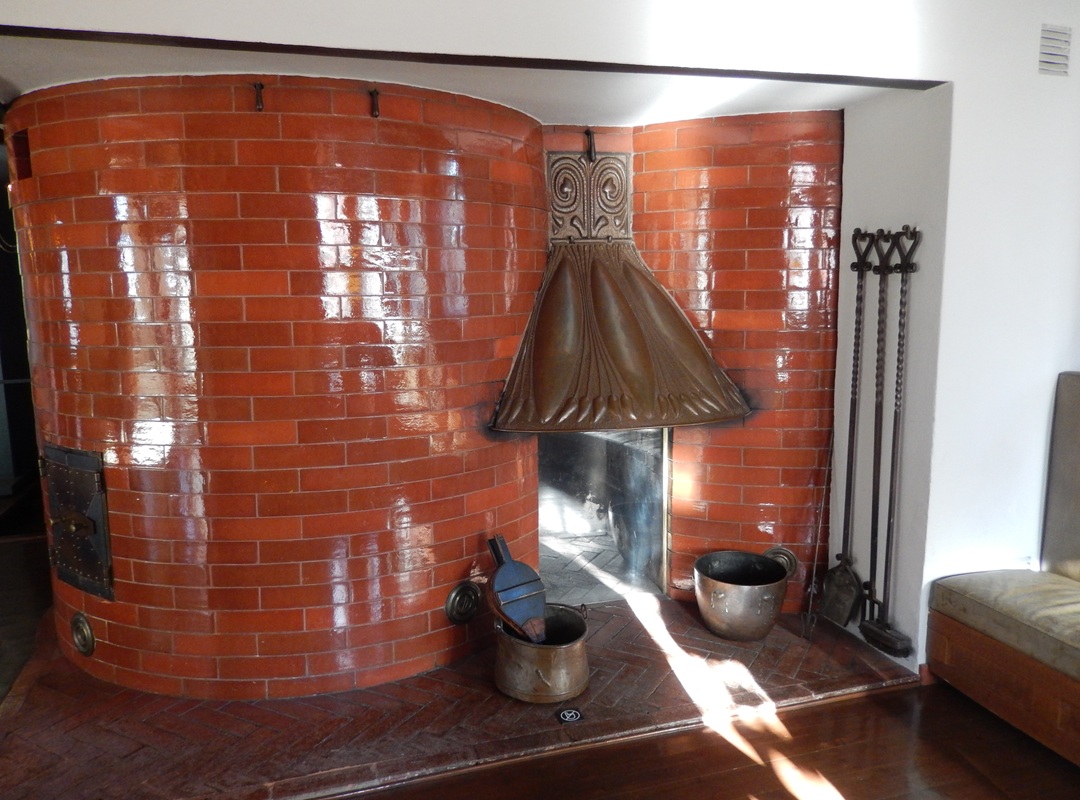
In the evening, Gallén-Kallela hastily painted one of the best valued portraits of Gustav Mahler – reported to Alma as “Ganz a’ la Rembrandt nur vom Kamin Beleuchtet”. The portrait is normally in Gösta Serlachius Fine Arts Foundation, Mänttä, but currently visiting Helsinki as part of the exhibition in Ateneum.
Parallel cultural transitions in Vienna
A quick look at the background is needed before discussion on the other image of Mahler in the Ateneum exhibition. I begin with the 1985 Mahler Festival in London. Claudio Abbado – one of the most important Mahlerians – and music director of the London Symphony Orchestra planned a complete cycle of Mahler symphonies and songs together with music of the ‘Viennese School’ (Schoenberg, Berg, Webern) and further amended by earlier and later composers. Abbado’s aim was to illustrate how the current music is a logical continuation of the great composers. In parallel Gustav Klimt’s art, Vienna Secession and other modernism (even in science) at the turn of the century was introduced under a title “Mahler, Vienna and the twentieth century”.
The Vienna Secession related paintings and craft-works are now presented in much wider scale in Ateneum, but when learning of this exhibition in Ateneum, I got a feeling – déjà visité – and had to revisit the London festival program magazine. I happen to have it, because had the pleasure of attending the concerts with M2 and M7, both conducted by Abbado, with Jessye Norman and Lucia Popp as soloists for the Mahler’s second in the Royal Festival Hall. And I remember how the Vienna Secession, Klimt in particular was exhibited linked to the music festival. So, I’m trying to sketch a mirror image reminding of the invisible link between the visual arts exhibited in Ateneum and the simultaneous modernism in music. And I found what needed in the London Festival program magazine, which contained Donald Mitchell’s introduction to cultural atmospheres in Vienna during the Mahler’s tenure in the Hofoper (1897-1907). Mitchell pointed out how the dualism and competition between ‘respected old’ and ‘emerging new’ was heated in transition from tradition to ‘avant-garde’. He found similitude and differences between the transitions in musical and visual arts.
Schoenberg and Zemlinsky (with Mahler as the honorary president) founded in 1904 a Society of Creative Musicians aiming for promotion of contemporary music. The manifest contained a provocative remark by Schoenberg, stating that “the only novelties likely to be heard in Vienna were in the area of operetta”. Indeed, the urban middle class loved operettas, where sugary tunes and dances sealed the happiness of a lovely noblewoman and an officer dressed in a gold-trimmed uniform. Meanwhile, many of our heroes in arts already sensed the approaching uncertain times and turmoil before WW 1 and end of the Austro-Hungarian Empire.
In music, the transition was not all abrupt. Music from different ages were performed for same audiences, though the contemporary music was typically disgusted. Mahler was able to support his protegees (even economically) and promote performing contemporary music. But on the visual arts side, Vienna was fully closed for modern art in any form. That resulted in the need for construction of a new building, the Secession, in Vienna. A group of prominent painters, architects and talents in applied arts were able to collect sufficient funds and raise the building in a short time. Fortunately, Hermine Wittgenstein (elder sister of Ludwig Wittgenstein) was a great admirer and collector of Gustav Klimt’s paintings. She was able to convince her father, Karl Wittgenstein, a great steel magnate for providing a good contribution.
And to learn about this revealing problem of the modernist visual artists i Vienna and how they were pushed to launch their branch of the Secession movement, I just needed to read an introductory article to a Mahler Festival written by a prominent Mahler discoverer, Donald Mitchell.
The Beethoven Frieze
“One of Klimt’s key works and a highlight of Viennese Art Nouveau”, is now displayed in the Ateneum as an officially restored copy. Important!
The 1902 Beethoven Exhibition epitomized the Secessionists’ vision of an encompassing synthesis of the arts. Twenty-one artists on architecture, sculpture and painting worked together creating a broad ‘Gesamtkunstwerk’ with a unified theme: a tribute to music of Ludwig van Beethoven on the 75th anniversary of his death. The objective was set to reunite the separate arts – architecture, painting, sculpture and music – under a common theme: “the work of art”.
At the center of the exhibition stood a Beethoven statue of Max Klinger. However, the biggest interest focused on the ‘Beethoven Frieze’ created by Gustav Klimt. The work extended over three walls with specific symbolism based on Richard Wagner’s interpretation of Beethoven’s Ninth Symphony. The figures illustrated the words of Friedrich Schiller’s “Ode an die Freude” in the final chorus of the symphony. The symbolism explained in the first exhibition brochure is introduced in an ‘artsandculture’ webstory.
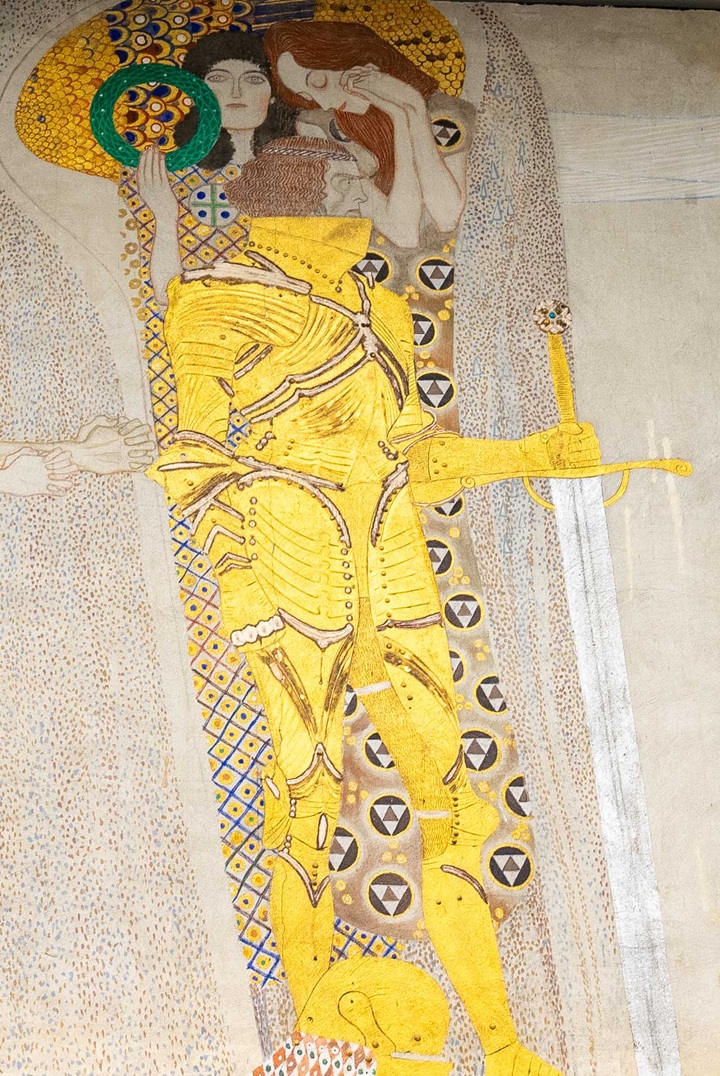
In short: The frieze begins showing female figures gliding along horizontally and representing “The Longing for Happiness”, meeting first three figures symbolizing “The Suffering of Weak Mankind”. They turn pleadingly towards a “Knight in Shining Armor” carrying a mighty sword. The Knight is being motivated by two inner driving forces, “Ambition and Compassion” to struggle for happiness in the name of humanity. … In the end, the third wall shows a female choir singing Schiller’s “Ode to Joy”. In between, the “hostile forces” are gathered on the middle wall.
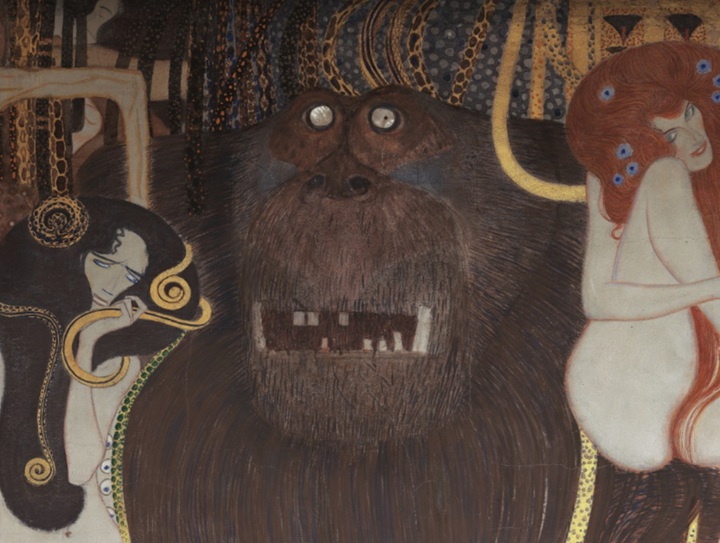
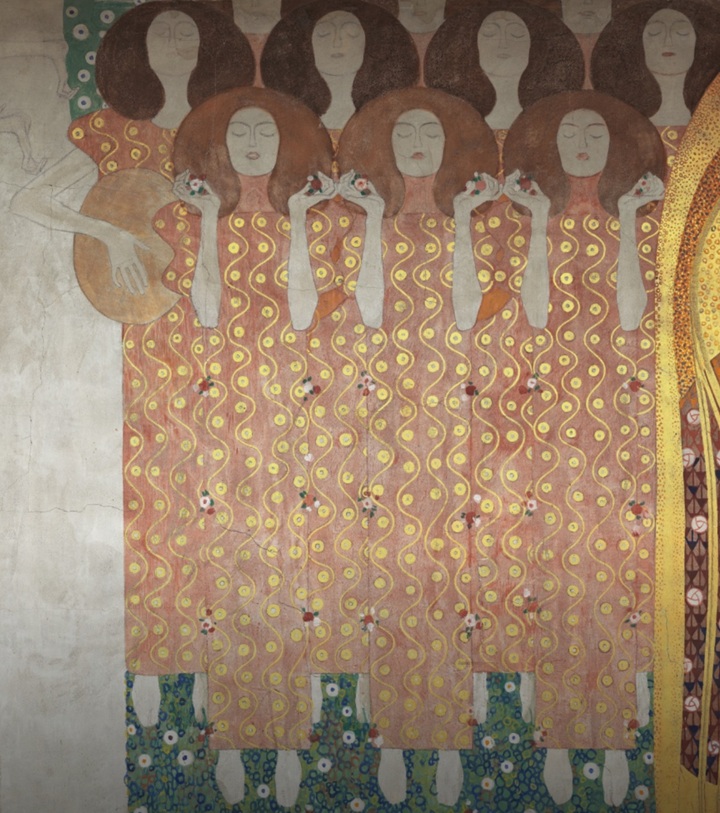
Who is the Knight?
The solitary knight is a hero of the Beethovenian battle guiding the mankind toward a final victory, liberated from darkness, suffering, temptation and doubt, slowly ascending towards happiness.
The knight is probably not supposed to represent any specific person, but Klimt implicitly acknowledged that he had taken his inspiration for the knight’s face from Gustav Mahler. Klimt liked opera and appreciated Mahler as its conductor. There is no reference of direct links between Mahler and the secessionists before the Beethoven Exhibition [¤], but I find it still possible that Klimt had discussed with Mahler on his challenge in transforming the “Wagner’s interpretation of Beethoven’s work” to visual art. As an expert on Beethoven and Wagner, Mahler would certainly have been a perfect partner for such discussion. He was known for analyzing and explaining the inner meanings of arts, and not only in music, in literature and other arts as well. For example, Alfred Schoenberg was impressed with his talent in explaining masterpieces.
For April 15th opening ceremonies of the Beethoven Exhibition Mahler proposed the Beethoven’s ninth performed by the Philharmonic Orchestra and Opera chorus, but due to practical problems, he prepared a brass arrangement of a segment of B9 finale, tuning the “Ode to joy” for six trombones. It would be interesting to hear that arrangement. There are notes reporting that it was impressive and deeply emotional for some of the exhibition organizers.
[¤] The marriage with Alma Maria Schindler, shortly before the Beethoven Exhibition established a direct link. However, friendship with Berta and Emil Zuckerkandl may have brought Mahler earlier in contact with the secessionists. As an anecdote, we may note that when Mahler first time met Alma at Berta and Emil Zuckerkandl in November 7th, 1901, Gustav Klimt and Carl Moll were also present.
Gustav and Alma Mahler – surrounded by secessionists
Gustav Mahler became closely involved with the Secession movement through his marriage with Alma Schindler (1879-1964). A proper study on her relations with secessionists would certainly grow broad and complex. It would start within the family:
Alma’s father Emil Jakob Schindler (1842-1892) was a highly respected landscape painter, an honorary member of the Vienna Academy and contributor for the “Austro-Hungarian Monarchy in Words and Pictures” – not a secessionist. Alma deeply adored his father who died, when she was 13. Her little sister’s father was a fellow painter Julius Victor Berger, who had briefly shared the apartment with Emil and his wife Anna Sofie – Alma’s mother, a singer. A couple years later, Anna Schindler was in another affair, now with her husband’s student Carl Moll, whom she married after Emil Schindler’s death. Alma’s relationship with her mother and stepfather became at least partially strained, but she enjoyed education in music and arts provided by top level mentors and tutors. Alma was growing and becoming a respected celebrity within the artistic circles.
Carl Moll was a co-founder of the Secession in Vienna. He introduced Alma to Gustav Klimt, who became passionate and gave her ‘the first kiss’ during a joint trip to Italy in 1999, but that game was abruptly stopped. According to Alma’s diary “our love was cruelly destroyed by my mother”. At the time of Mahler’s entry to the picture, Alma was in love with her tutor in composition, Alexander Zemlinsky (tutor also for Arnold Schoenberg), whom she had been ‘torturing’ for long.
It all started overnight on November 7th 1901, at a soirée hosted by Berta and Emil Zuckerkandl, who had sensed Alma’s interest in Mahler. Mahler was not interested in social dining, but misleadingly invited for a dinner just with Zuckerkandl’s and Berta’s sister Sophie (married to Paul Clemenceau in Paris). However, Berta invited more people, including Gustav Klimt, Carl Moll and Alma. A long discussion revealed Alma’s deep understanding of music, which certainly increased Mahler’s interest. Alma had low regards for her stepfather and tensions with her mother, but very high esteem of the late father, a great artist. This may have partially contributed to the marriage with an elder, not so well-dressed, but ‘superhuman’ director of the Opera. In addition, after her mother and stepfather got a common child, Alma’s long term socioeconomic status was not secured and Mahler was a good choice in that respect. In any case, they both fell fast in love, as verified by Gustav’s reported behavior and Alma’s diary. The engagement was in 7 weeks and wedding in 4 months after the soirée at Zuckerkandl’s.
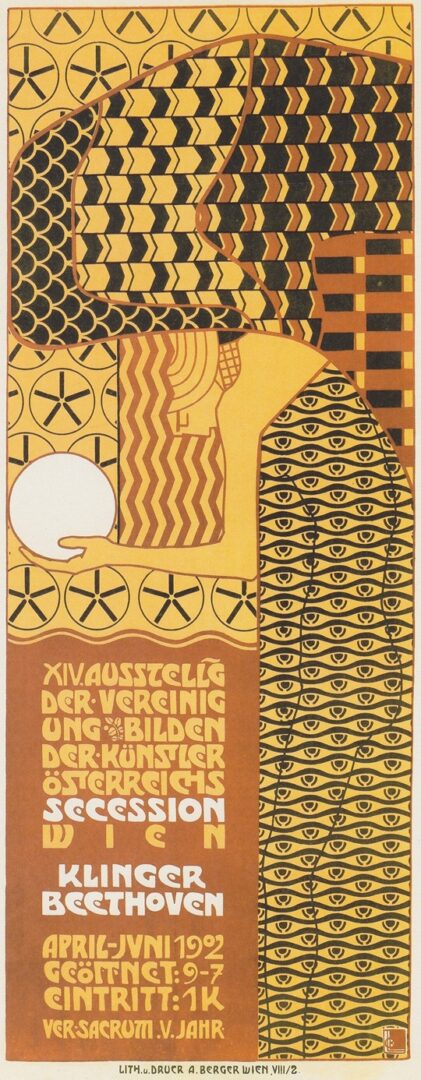
Mahler and Alfred Roller
Alfred Roller, was a co-founder of the Vienna Secession, editor in chief for their Magazine ‘Ver Sacrum’ (sacred spring) and president of the Secession in 1902. His poster for the Beethoven Exhibition was an iconic example of the new ‘Secession style’ in graphic art.
He became a close partner with Mahler in modernization of the Hofoper. Their collaboration is worth of a separate story. An extended overview will probably appear also here, but a proper study is easily available in form of a doctoral thesis of Stephen Thursby: “Gustav Mahler, Alfred Roller, and the Wagnerian Gesamtkunstwerk”, Florida State University 2009.
Thursby and La Grange [LG-GM, vol.2, p. 357-358] both refer to comprehensive studies by Franz Willnauer [#], who provided a comprehensive insight into Mahler’s artistic work at the Vienna Hofoper.
Opera, a ‘complicated and integrative mechanism’
Mahler had to defend the Hofoper’s artistic autonomy – or the director’s power’s – to achieve the ambitious goals in his new productions of Wagner’s Tristan, Die Walküre, and Beethoven’s Fidelio, and to provide musical drama rather than to showcase beautiful voices. In a letter to his superior, Obersthofmeister Fürst Montenuovo, Mahler explained the opera as an integrative mechanism, a ‘totality that rests on the interaction of its components’. This argument fits well together with his devoted Wagnerian mind.
Wagnerian “Gesamtkünstler”
Willnauer proposed that Wagner was the creator of “Gesamtkunstwerk”, and Mahler the “Gesamtkünstler”. He not only planned the repertoire, selected soloists, directed and conducted performances, he also rehearsed the singers and orchestra, tutored assistant conductors and soloists, and got involved in stage designs. Physical improvements included lowering of the orchestra pit to achieve a “Bayreuth-like” sound balance between the stage and pit, first turning, then rotating stage for dealing with heavy set pieces, darkening of the theater and keeping the doors closed during the play.
No doubt, Mahler was deeply committed to reform all standards at the Hofoper. One example: on third day as the Director Mahler issued a directive on banning contact between singers and the ‘claque’ in the audience, people who were paid or given free tickets to cheer loudly for the hosting singer during a performance. Implementation of this directive was not easy, but Mahler even placed “detectives” to determine if the claque was still at work.
[#] Franz Willnauer, “Gustav Mahler und die Wiener Oper”,
Jugend & Volk, Wien & München, 1979, 314 seiten.
– Franz Willnauer (1933 -), is a scholar and art manager
Artistic director of the Salzburg Festival (1985–1991),
Schleswig-Holstein Music Festival (1996–1998) and
International Beethoven Festival Bonn (1999–2003).
Alfred Roller – from Secession to Opera
Alfred Roller was a painter and graphic designer. He appreciated opera, in particular Richard Wagner’s ‘Tristan and Isolde’. Roller became interested in new concepts of opera stage design and prepared some draft stage designs for the ‘Tristan’, and possibly also for Wagner’s ‘Rienzi, der Letzte der Tribunen’.
Gustav Mahler and Alfred Roller found each other in a heated discussion on the visual aspects in opera performances. In her memoirs, “Gustav Mahler: Memories and Letters” (1940 German/trans. 1946), Alma Mahler-Werfel explains that they visited her parents home at the Hohe Warte, where the secessionists often met. According to Alma, Mahler and Roller fell into lively discussion after Roller remarked that he had never missed a performance of Tristan, but enjoyed only listening to the music, because the stage-setting destroyed the whole illusion. If true, this would have been a sure trigger for Mahler, because he was also disappointed with the current designs and planned for a revised Tristan, to commemorate the 20th anniversary of Wagner’s death on February 13th 1903. Alma wrote:
‘Mahler asked him what he would do about it himself and
Roller replied by unfolding schemes of such magnificence
that Mahler gave him an appointment at the Opera next day.
“That’s the man for me — I’ll engage him,”
he said to me on our way home.’
In reality, this must have occurred during early spring 1902 before their wedding and the appointment as chief stage designer to the Hofoper took more time, until 1903. However, it seems obvious that – without any formal appointment – Mahler instantly agreed with Roller that he would take over the responsibility of all visual aspects for the revised ‘Tristan and Isolde’, which was to be premiered on February 13th 1903 (but postponed for a week to 21st ).
According to La Grange, Mahler had informed Anton Brioschi and Heinrich Lefler and forwarded Roller’s new sketches to Heinrich Lefler already in May 1902. Further, Roller submitted a cost estimate on a complete new set of costumes in May 31st. Anton Brioschi was the stage designer. Heinrich Lefler was recruited by Mahler for set and costume design and he contributed to the Tristan project with Roller. [LG-GM, vol.2, p. 561].
Mahler – Roller “Gesamtkunstwerk”
Contemporaries’ accounts described Mahler’s involvement in directing the stage by explaining how to convey the overall impression of the libretto and composition to the audience. The visual aspect of the performance was also important, but everything should be compatible with the spirit of the music.
Both Mahler and Roller were familiar with the writings of the Swiss architect and stage design theorist Adolphe Appia, who advocated three-dimensional, suggestive staging and the dramaturgical use of light. Today, it is difficult to imagine an opera without these elements, but in 1903 Hofoper, that meant revolutionary stage design. Furthermore, only 20 years after Wagner’s death, it was a big surprise not to respect the tradition developed in Bayreuth, although Wagner’s own ideas were to be followed closer than in Bayreuth.
Instead of decoration or imitation of reality, Roller wanted to strengthen the imagination aroused by the music. He used groundbreaking lighting solutions that also required new technology. Particularly exceptional was his use of color and darkness in accordance with Appia’s theories. As a painter, he could probably also draw inspiration from the Impressionists. But there were practical concerns on Roller’s dark stages, since performers could not easily see and react to their fellow actors’ faces, and the audience would not be able to follow the onstage action as easily. [#]
Anna von Mildenburg, one of the most celebrated Wagner sopranos, who had debuted in 1885 at the Hamburg Opera under Mahler’s direction and instruction, joined soon Mahler’s team in Vienna and was now in the role of Isolde. During the rehearsals, she first opposed all initiatives of Roller and refused to wear his costumes. Mahler recommended that Roller and von Mildenburg get to know each other outside of work. That helped and von Mildenburg became soon Roller’s defender in all disputes over his work. [##]
[#] Considering how Roller had claimed to
have listened to the opera with his eyes closed,
limited visibility may not have been a problem for him.
[##] Perhaps Alfred had also been able to communicate
his appreciation on Anna’s earlier performances as Isolde.
Roller was a hard working artisan, totally dedicated to the cause of art. He had made drawings, paintings and models of each scene and set before building, starting from analyzing the score, the mood, rhythm and momentary atmosphere. The relevant extract of the score was attached in each plan. He applied a dominant color palette for each act and the visual style was associated with ‘Secessionist’ or ‘Impressionist’ in newspaper critics. The following examples are copied from the doctoral thesis of Stephen Thursby:
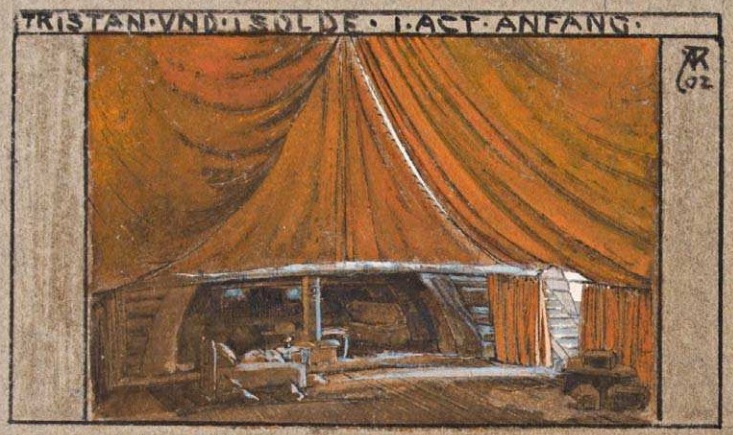
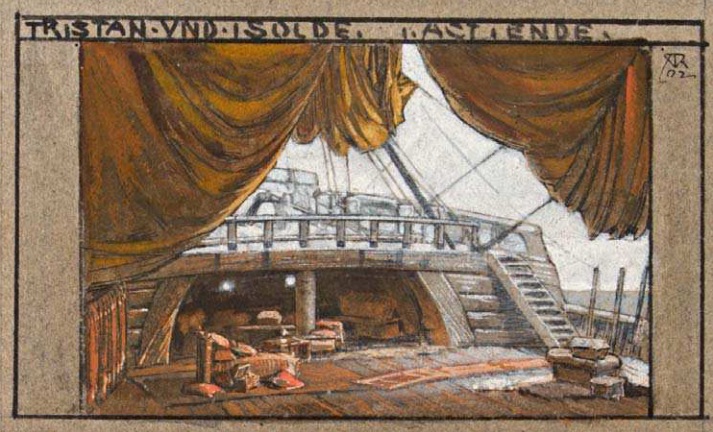
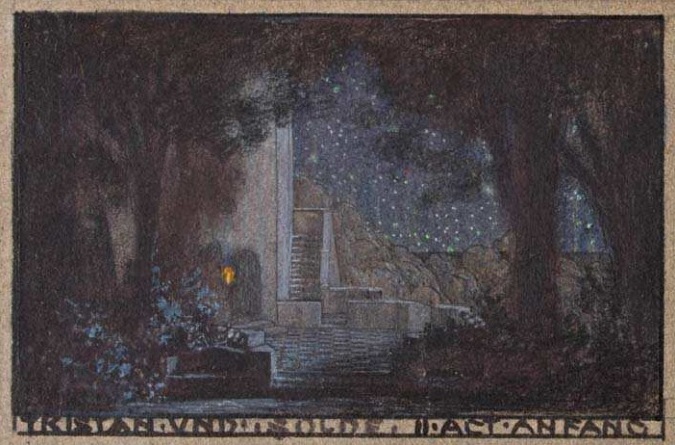
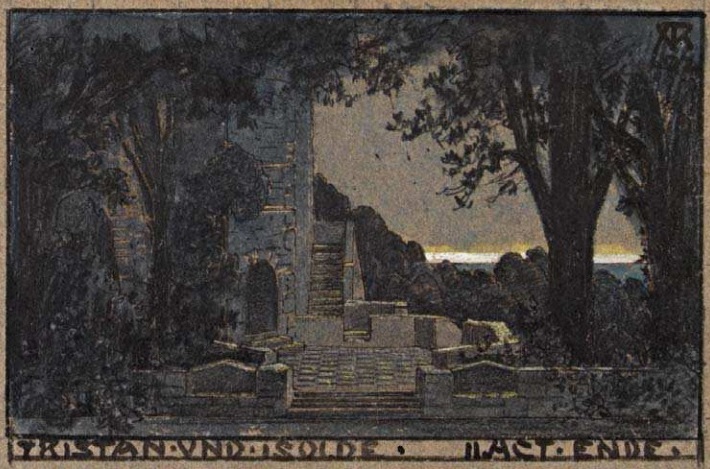
The first “Mahler – Roller Gesamtkunstwerk”, the reborn ‘Tristan and Isolde’ was a great success, commonly considered a landmark that followed the Wagner’s original idea of Gesamtkunstwerk better than he could achieve himself. The contributions by Roller played an important role and the “Secessionist” or “Impressionist” visual style was surprisingly well accepted also by the strictly conservative critics. [#]
Mahler’s aim was to create model performances requiring the full effort from everyone involved, and now he had found a perfect partner for visual design. Mahler and Roller had much in common, in their modest family background in Bohemia/Moravia, mentality, aims and the way of working: ‘art is 90% work, rest is talent given’. They became friends and Mahler tried to persuade Roller to follow him to New York for transforming the visual designs at the Metropolitan as well. Roller had left his teaching post [##] when appointed chief stage designer to the Opera, but returned teaching in 1909.
[#] Adolf Hitler spent a lot of time in the Hofoper. During his first trip to Vienna he attended ‘Tristan and Isolde’ on May 8th, 1906. He was deeply impressed by the set designs of Alfred Roller. Hitler had later estimated having seen ‘Tristan’ forty (40!) times in Vienna, and naturally a lot of other Wagner operas as well.
My source was: Jamie Dickey (2004); “Made in Vienna: The Indoctrination of Adolf Hitler”; The Mirror – Undergraduate History Journal, 24(1), 119–147. (University of Western Ontario)
[##] Kunstgewerbeschule Wien (School of Arts and Crafts, affiliated with the Imperial Royal Austrian Museum of Art). Part of the Secessionists studied in this school, including Gustav Klimt, Oskar Kokoschka, Egon Schiele.
In summary
As Donald Mitchell noted in the London Mahler Festival program magazine in 1985, there were parallel revolutions going on in Vienna during the Mahler’s tenure in the Hofoper. We can see now, how the ‘emerging new’ replacing the ‘respected old’ in the Hofoper was directly connected to the Secession movement, and Alfred Roller was a key player on both sides.
Back to Ateneum – to see Amalie Zuckerkandl
We started from the exhibition in Ateneum and must return to close this story. I got interested, why an uncompleted painting of Amalie Zuckerkandl and her dress by Gustav Klimt had been selected as the front picture of the exhibition. Is there a story behind?
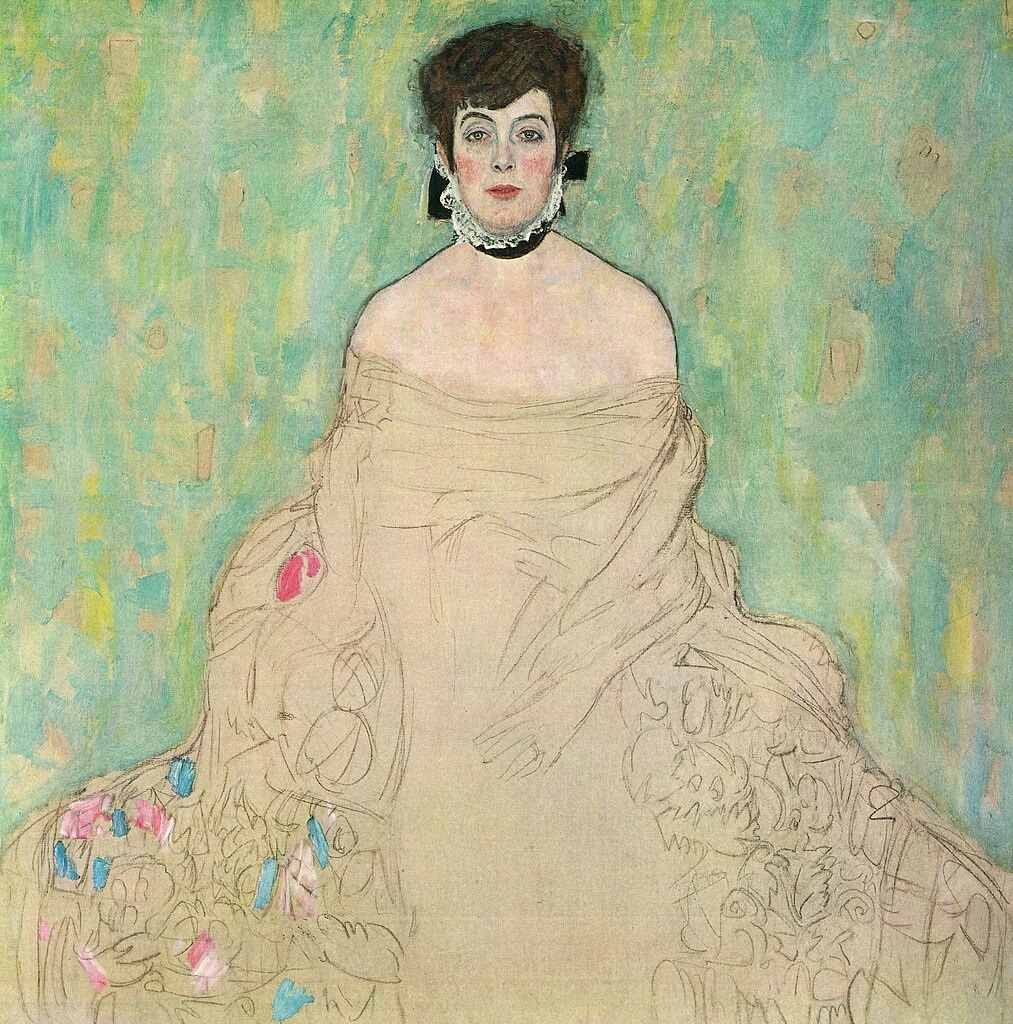
Gustav Klimt was painting many women from the upper echelons of Viennese society. Could it be that Amalie Zuckerkandl was one of them? If so, she might have known Gustav Klimt from the society salons which brought together artists, scientists and businessmen, many of whom were financial supporters of the Secession. On the other hand, though the drafted dress was left unfinished in the painting, it might have played a role in linking the model and the painter. The dress might well be designed in a Secession linked salon. Emilie Louise Flöge was the life companion of the painter Gustav Klimt and the owner of the haute couture fashion salon Schwestern Flöge (Flöge Sisters). But a most plausible explanation for this portrait comes through the extended Zuckerkandl family.
Amalie was married to Otto Zuckerkandl, a medical doctor and surgeon, who followed the model of his elder brothers in supporting modern art and commissioning Klimt for a portrait of Amalie in 1914. The work was interrupted, because Zuckerkandl’s left to Lviv, where they worked as a nurse and doctor during the First Word War. Klimt aimed to complete the painting in winter 1917/18, but it was left unfinished as he died in February.
Otto’s elder brother Victor, a successful industrialist had financial possibilities to compile an extensive art collection, mainly Viennese old masters, but also important works of Klimt. The portrait of his wife Paula may have provided the immediate model for Amalie’s portrait. However, the idea of supporting Klimt came to the Zuckerkandl’s most probably from Berta Zuckerkandl.
The eldest of brothers, Emil Zuckerkandl held the first chair for anatomy at the University of Vienna. He was a liberal thinker (hired the first female university assistant in the Empire), fond of music and collected art. He was married to Berta Szeps, an intellectual writer, art critic and co-founder of the Salzburg Music Festival. Berta and Emil Zuckerkandl supported young artists and hosted a salon for artists including Klimt, other secessionists and musicians. They were also responsible for pairing Alma and Gustav Mahler by cheating him to a group soiree. According to Berta and [LG-GM, vol.2, p. 420]: when leaving, Mahler had assured that for the first time in his life he had enjoyed dining out.
The exhibition is closing February First 2026, …!
(and checking the Beethoven Frieze in Gallery 3.9 at even hours adds the experience with a short clip of music)