The final note of the Trauermarsch in M5
The first movement “Trauermarsch” in Mahler’s 5th symphony ends with a distinctive single note pizzicato by violins, cellos and basses. Timo had compared various recordings and observed notable differences in the emphasis given for this “pizzicato for tutti”.
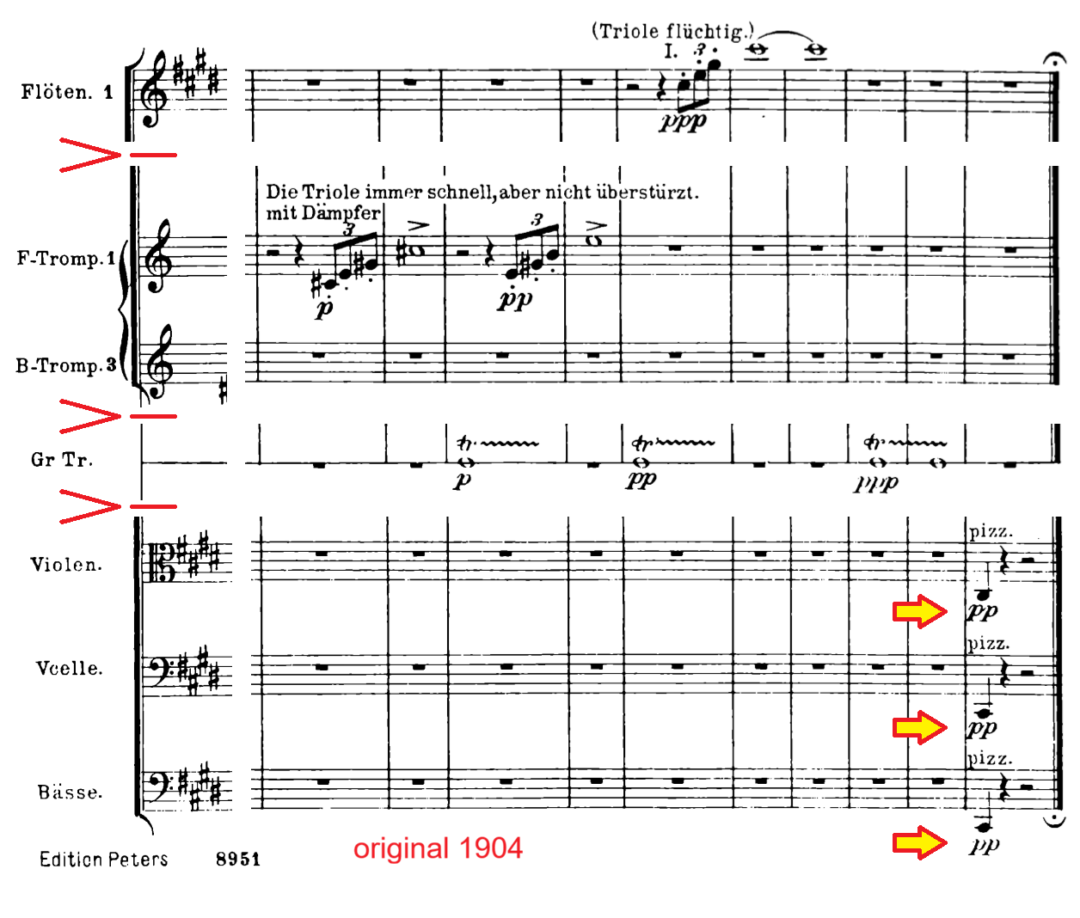
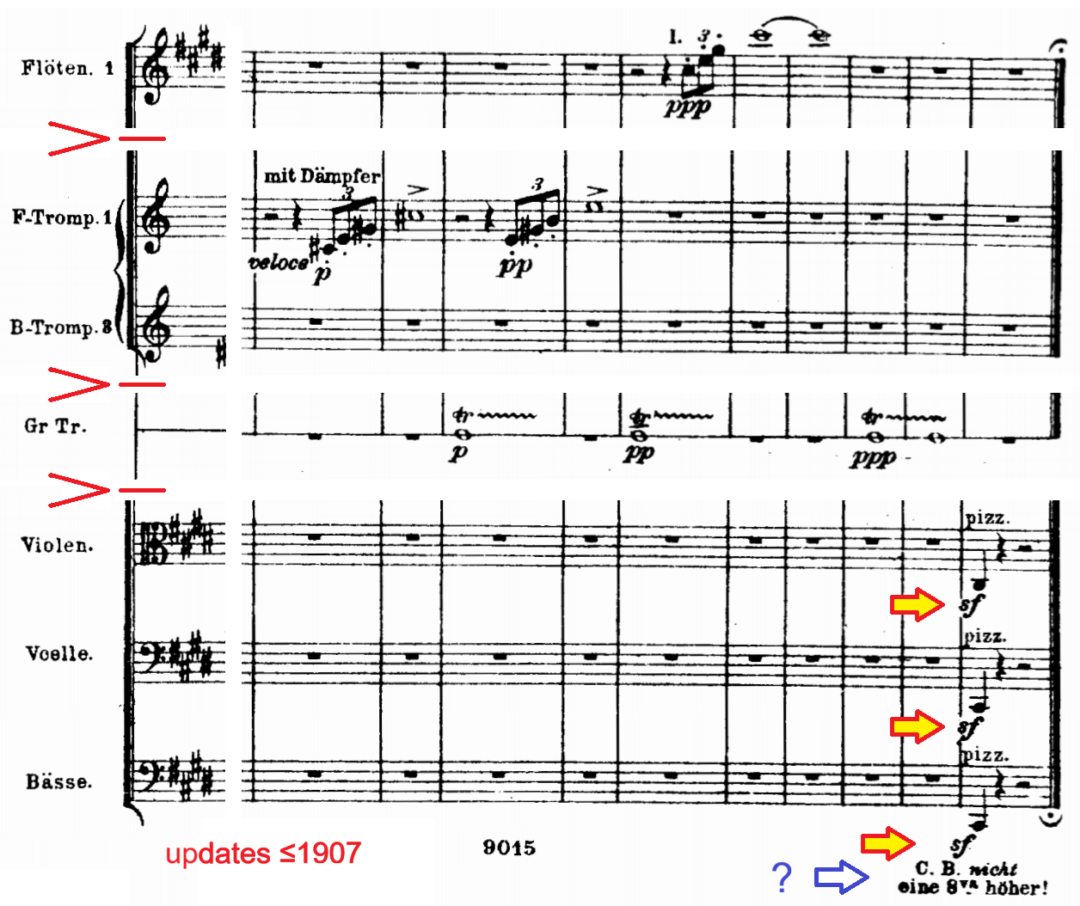
At least the conductors reading of the score, string players response, sound engineers work and even acoustics may result to differences in sound, but a closer look to the score versions revealed an update, which could explain even big variations, if different edits of score were used.
Mahler naturally performed fine tuning to his scores when rehearsing and hearing them. For example, it has been suggested that “part of his symphonies are tuned for the Amsterdam Concertgebouw acoustics”, simply because Mengelberg, the orchestra and audience eagerly welcomed Mahler to conduct his own music there. Mahler did some further tuning in orchestration of M5 still later, but we compare the manuscript (1903), the original before the first performance printed score “Peters 1904” and the revised print “Peters 1907” which covers the changes made before sailing to N.Y., i.e., for the November 9th concert in St Petersburg on return from Helsinki.
The following – for clarity edited – extracts reveal what we found. The “pizzicato for tutti” was originally marked with “pp” in line with the gradually softening preceding tunes, but changed to be played louder. First the original “Peters 1904” and below the revised print “Peters 1907” :
The manuscript confirms that the “Peters 1904” was printed as intended:
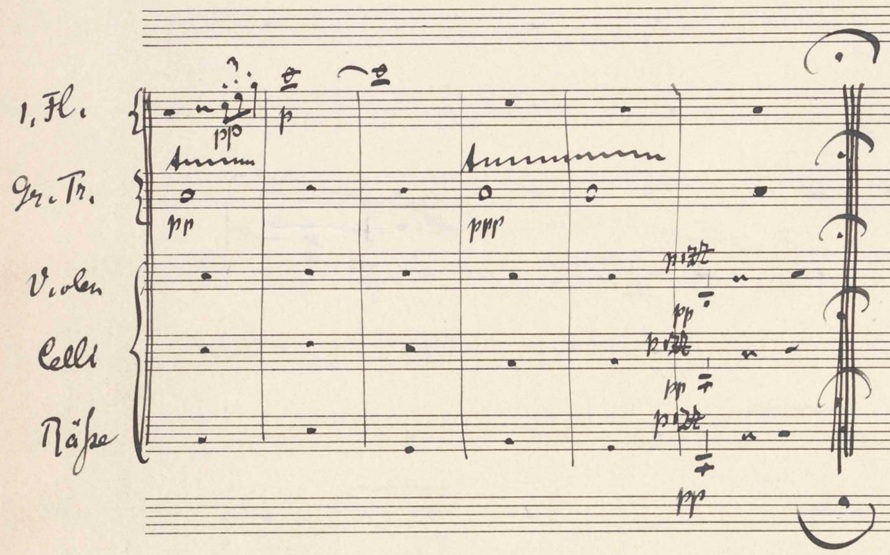
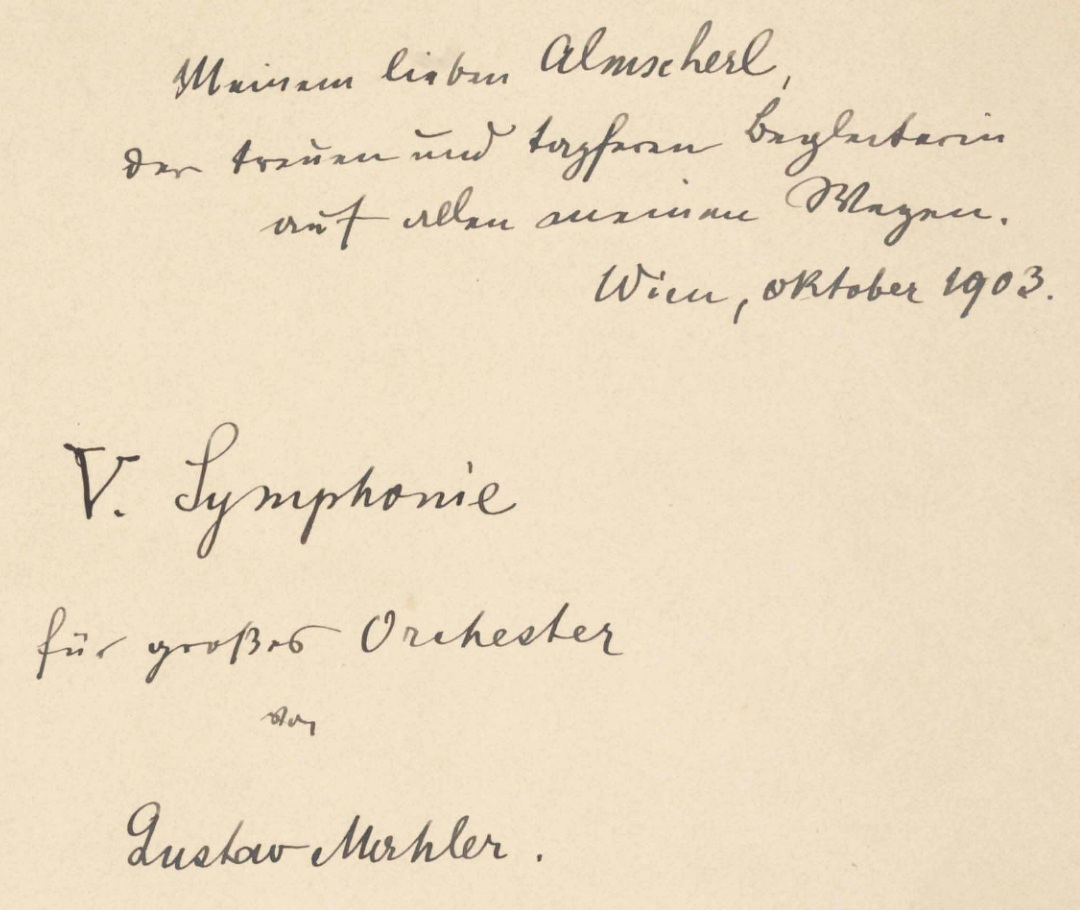
As shown, a performance using the 1904 printed ‘draft’ score would certainly cap the first movement Trauermarsch much differently. Could it be that the ‘conductor Mahler’ realized an interest of providing here a sharp cap, a movement closing statement for the audience, something which the ‘composer Mahler’ did not see. We know that Mahler provided recovering pauses after exhausting movements like this Trauermarsch (two minutes in Hamburg 1905). An audible note also separates the pause from towards the silence dissolving music.
But how probable is it that the 1904 ‘draft’ version would be used in a recording? We cannot assume that this finding is a sole and conclusive explanation for different ways for closing the Trauermarsch. It seems that most conductors and orchestras follow the updated idea as expected – or almost as expected, but it is always possible that musicians are rooted to different traditions. For example, a senior tutor, who has in youth learnt this symphony with the 1904 score, may have suggested to reduce the emphasis given to this particular note. Furthermore, modern musicians and conductors have difficulties following Mahler’s ideas of ‘poor playing’. There is a second dimension in our case. In addition to volume of sound, also quality of sound. A question remains: should this pizzicato be played
- abruptly and loud, but maintaining delicate sound of instruments,
- or not caring of the quality of sound, rather differentiating from normal playing.
M1-3 “Frère Jacques” (mockery song used as a Funeral march) is a well known example. It begins by a double bass solo, which Mahler at the time could not expect and wanted not to be played delicately as it is usually played nowadays. It has been noted that he often preferred effect/impression/… instead of beauty of sound.
Last minute of the Trauermarsch
Timo’s observation raised interest in a small but audible detail, which the composer could adjust by minor markings in the score. And before finding the adjustment in the score (above), this issue was addressed by comparing some selected recordings focusing on the end of the movement.
A set of clips containing the last minute of the Trauermarsch was collected for comparison. These last minute samples are preceded by loud playing of the orchestra. Other trumpets have kept on reminding of the “fate knocking the door”, while the intensity of the orchestra gradually reduced. Our CD samples begin when the first trumpet (without mute) takes over for a solo, during which the orchestra leaves him playing alone for his/her two last bars. Next the brass and wind sections discuss with strings (only cello and bass in begin). Meanwhile, the first trumpeter has inserted a damper and returns for the last reminders “con sordino” with the flute. Distant drumming behind (lowering of a coffin to the crave?) is hardly audible, but the string pizzicato announces that the funeral procession is completed. The 10 bar score extracts above begin with the “trumpet con sordino” and the manuscript last page with the flute.
Audiovisual examples
I suggest to start with an audiovisual introduction, about 70 seconds from one of the three RSO concerts in Areena. These links lead to 10 seconds before the trumpet solo, i.e., 9 s. earlier than the CD clips. The video recording of 2019 shows nicely the active instruments and in addition to the trumpet by Jonas Silinskas, focuses also to the flute by Kaisa Kortelainen:
[RSO – Nicholas Collon 2024] ; [RSO – Ryan Wigglesworth 2019] ; [RSO – Hannu Lintu 2015]
CD recordings
Recordings of six conductors and orchestras were selected. Four of the orchestras are known of particular Mahler experience in New York, Chicago, Amsterdam and London. The spectrum is expanded by Vienna and Caracas. Five of the conductors had long experience in conducting Mahler before these recordings listed in chronological order as follows:
- Bruno Walter was Mahler’s closest protege and witness of the M5 premiere in Cologne, October 18th 1904
- Claudio Abbado has done a lot in introducing and playing Mahler for audiences in Europe and Chicago
- Leonard Bernstein was famous of introducing Mahler in New York and media, also in Europe
- Riccardo Chailly as conductor of the Concertgebouw Orchestra is a mandatory reference here
- Benjamin Zander made a Mahler cycle with the Philharmonia Orchestra and lectured on Mahler’s symphonies
- Gustavo Dudamel with the Simon Bolivar Youth Orchestra of Venezuela is a pick “out of the old boys box”
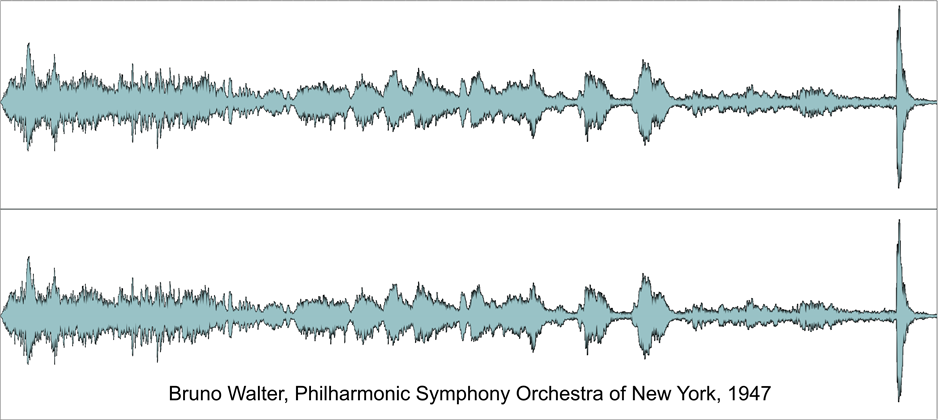
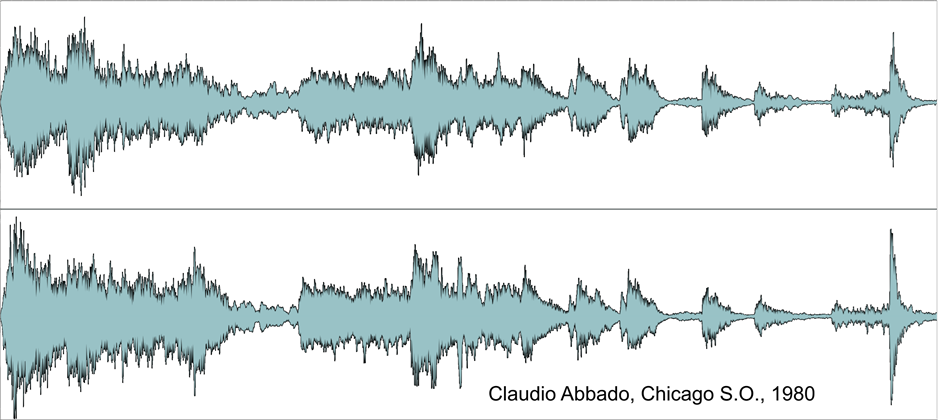
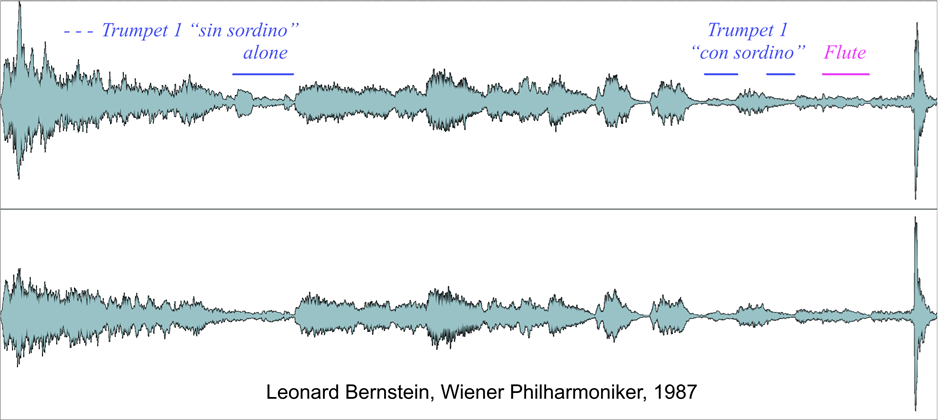
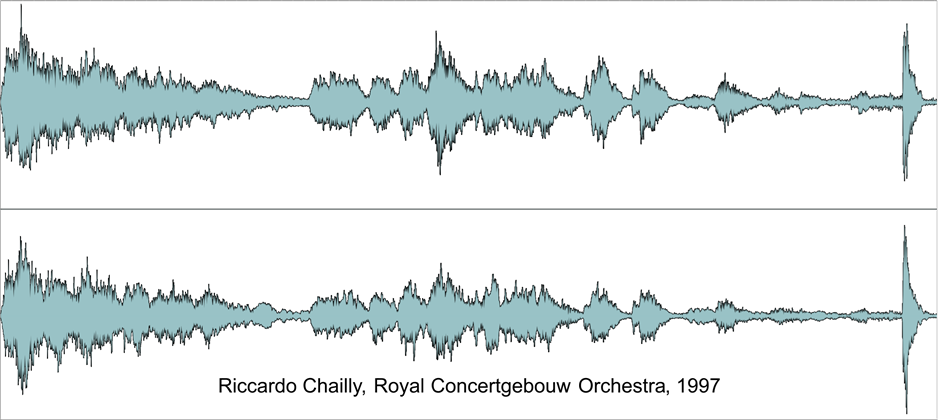
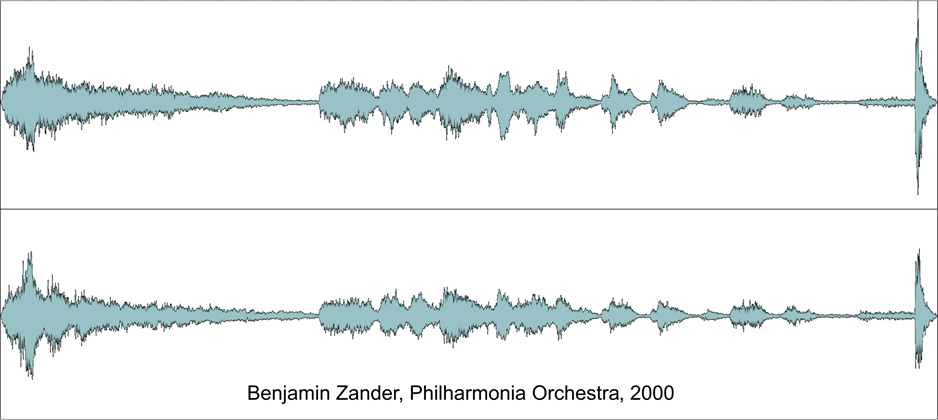
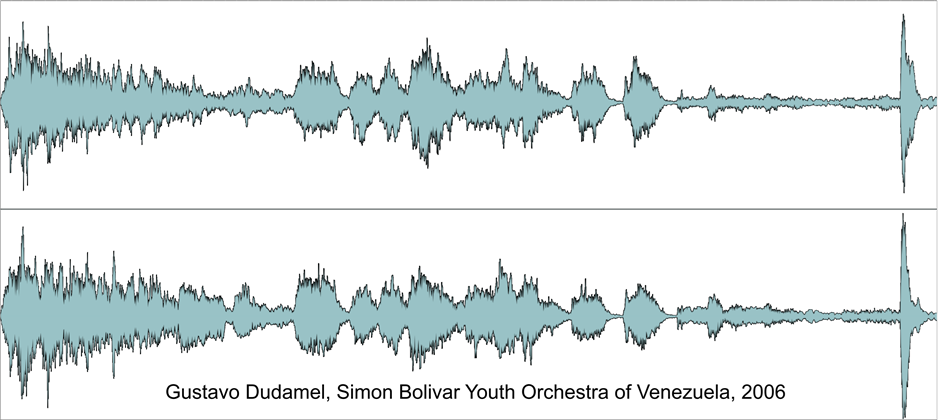
The recording technology in 1947 certainly makes a difference (with Walter), but all recordings, except Walter and Abbado are digital. When listening to the clips, graphs of the sound volume variation may help visualizing some differences between the CD performances. The volume graphs (L/R) are scaled for visibility and the sound clips are amplified to 250%, because this minute contains music from very low to moderate volume. A couple ‘milestones’ are marked in the Bernstein graph.
Some thoughts rising when listening the clips in row
Assuming that each orchestra plays as instructed by the conductor, we address the remarks to the conductors. Please note that the remarks below are based on instantaneous feelings and may also be affected by subjective presumptions, just by name of the conductor.
Bruno Walter: The closing pizzicato sounds loud and rough, as if Walter had instructed “don’t try to play it beautiful, rough and loud suits better”. As usual, Walter also applies relatively high tempo, the highest in this comparison, but he seems to slow down a bit towards the end.
Claudio Abbado: He seems to provide a more gentle, beautiful and less dramatic interpretation. The closing pizzicato is perfectly played without exceeding the normal sound scale of the string instruments.
Leonard Bernstein: He applies here very slow tempo, much slower than the others. The atmosphere sounds gloomier than with Abbado. The closing pizzicato is loud and rough, as following the model by Walter. He was certainly well familiar with Walter’s interpretations on Mahler.
Riccardo Chailly: This presentation begins in a less dramatic mood, largely thanks to the airily played “trumpet sin sordino”, but grows afterwards more dramatic, until the beautiful sounding flute. The closing pizzicato is a loud but still beautiful cap for this movement.
Benjamin Zander: This presentation is clearly structured in phases, which is hinted also in the sound volume graph: steadily decreasing intensity until end of the “trumpet sin sordino” and clearly visible ‘events’ after it. In comparison with Chailly’s trumpeter, Zander’s “trumpet sin sordino” continues longer in dramatic mood, which stays present to the end. The closing pizzicato is loud and dramatically played. We can hear wood in addition to the vibrating strings, similar to Walter and Bernstein.
Gustavo Dudamel: it is difficult to avoid premonitions (positive expectations and/or questions on experience) when knowing that a youth orchestra is playing with a young conductor in a rocket rising fame. However, I guess that Dudamel has studied well the Mahler tradition and/or had good tutor(s). He keeps the orchestra playing quietly from early on leaving space for Francisco “Pacho” Flores, who does a good job with his “trumpet sin sordino”. After that Dudamel keeps a calm pace with limited drama, perhaps according to the model of Abbado. The later Pacho’s “con sordino” could be a bit more dramatic to my mind. The closing pizzicato is louder than with Abbado but similarly beautiful, emphasizing low strings “avoiding woodwork”, even better than Abbado.
- Well, well, … after writing this, my memory started messaging about “Abbado in Caracas?” and indeed, Google agrees that Abbado conducted and tutored the orchestra at least for five years (part time, naturally) in Caracas and on tours.
- He also brought the Simón Bolívar Youth Orchestra of Venezuela as the orchestra in residence to Lucerne Festival in 2010, as confirmed by a good recording of Tchaikovsky’s sixth symphony [Pathétique]; or (in particular for Juho) a [trailer] beginning with Sergei Prokofiev’s Scythian Suite.
- Furthermore, Google found a quotation of Gustavo Dudamel on Claudio Abbado: “His endless generosity and love touched me at a very early age and will be always one of the most valuable treasures in my life.”
Summary on the last note in Trauermarsch
Having listened these six CD examples and looking back to the RSO concert recordings used for introduction, one cannot avoid comparing the RSO concerts with the CD clips. In each three concerts conducted by Nicholas Collon 2024, Ryan Wigglesworth 2019 and Hannu Lintu 2015, quite moderate weight seem to have addressed for the closing pizzicato note – weight in terms of volume and roughness of sound created. Closest match for Collon, Wigglesworth and Lintu seems to go with Abbado – based on this one bar within about 75 minutes of M5.