Songs on miseries in summer 1901
Additional reading linked to
“Mahler 5 – Fate Symphony / Love Song?”
Four famous sets of songs by Mahler are of interest, not only as separate masterpieces, but also due to the links with the symphonies, which are commonly divided into subgroups. The preceding M2-M4 are referred as the ‘Wunderhorn symphonies’. The fifth is composed at a turning point where the way of composing changed towards ‘absolute music’ and incorporating songs was suspended. M5-M7 (or M5-M8) are listed as ‘middle period symphonies’. The four song cycles are
- “Lieder eines fahrenden Gesellen” – ‘Songs of a Wayfarer’ to Mahler’s own words
- “Des Knaben Wunderhorn” – ‘The Boy’s Magic Horn’ based on German folk poems
- “Rückert-Lieder” – to selected poems by Friedrich Rückert; 4 of 5 in summer 1901
- “Kindertotenlieder” – to a specific group of poems by Rückert; 3 of 5 in 1901
The four songs in “Lieder eines fahrenden Gesellen” were composed already 1884-1885. Not relevant here.
“Der Tambourg’sell”
The German folk poems collection “Des Knaben Wunderhorn” provided ideas for 23 songs since 1887. Without a precise plan Mahler composed one more song for this series in summer 1901. A musical idea had suddenly sprouted up when Mahler was aiming for the symphony. Then he realized that it was not a symphonic motif and was not applicable as such to M5, but fitted perfectly to the Wunderhorn poem “Ich armer Tambourgesell”. So he completed the song “Der Tambourg’sell” and then referred its funeral marches also in the “Trauermarsch” of M5. This is confirmed by a detailed study on the musical similarities [Donald Mitchell: “Discovering Mahler”, p. 200-243]. I think that similarities can be described also from a narrative point of view.
Let me remind here of the subtitle Mahler gave for the third movement of M1: “Totenmarsch in Callot’s Manier” – ‘Funeral March in the Manner of Callot’, and suggest that he could have given a related reference also for the Part 1 in M5. Jacques Callot (1592–1635) was an early pioneer of etching and copper engraving, known for grotesque graphics depicting misery and misfortune, especially in the collection “Les Misères et Les Malheurs de la Guerre”. It illustrated the “Thirty Years’ War” (1618-1648).
Achim von Arnim and Clemens Brentano compiled and published “Des Knaben Wunderhorn” collection (1805–1808) during the Napoleonic Wars and French military occupation over German lands. Several Wunderhorn poems and Mahler’s songs deal with a war or its consequences. “Der Tambourg’sell” is a profoundly pacifistic funeral march on a child amid miseries in a war highlighting the tragic waste of young life:
A boy serving as a drummer apprentice in the King’s Bodyguard has left his duty and is now in prison looking at the gallows where he will be hanged in the morning. The boy addresses touching childish farewells to the marbled castle, its surroundings, the officers and soldiers.
I assume that Mahler revisited at least mentally the “Callot’s Manier” in summer 1901 when composing the song “Der Tambourg’sell” and Part 1 of M5. This assumption leads me to suggest that in “Trauermarsch” the trumpet blasts warnings on development of wars, revolutions or other unrest with all their miseries. This doesn’t exclude concerns about other kinds of miseries that Fate may offer. The crushing turmoil in loud brass and percussion could be easily assumed as ‘voices of armies’, or sounds of other brutal power. However, Mahler was concerned on the wars from common soldiers – kids and young, inexperienced boys, as well as civilian human points of view. I invite Mahler’s long term trusted friend and first hand witness Natalie Bauer-Lechner to confirm his point of view.
Testimony of Natalie Bauer-Lechner
Natalie Bauer-Lechner had graduated from the Vienna conservatory already before Mahler arrived, but she (or her sister) had realized the young student’s talents in the conservatory and in the arts oriented sub-group of the Pernerstorfer Circle for Viennese intellectuals interested in politics, philosophy, poetry, music, and theater. Later on, she became a part time ‘family member’ [to be addressed later]. Natalie spent summers with the Mahler’s (Gustav & sister Justine) and witnessed composition of M2-M5. She kept detailed journals on Mahler’s life and works (collected as “Mahleriana” and “Erinnerungen an Gustav Mahler”). Natalie Bauer-Lechner remembered Mahler feeling himself as a ‘spokesman for the suffering inherent in the human condition’. According to her, Mahler described the newly composed songs, “Der Tambourg’sell” and first songs of the “Kindertotenlieder” as follows:
‘it hurt me to write them and I grieve for the world which will one day have to hear them, they are so sad.’
“Kindertotenlieder”
During the summer 1901 Mahler composed seven songs based on poetry by Friedrich Rückert, three of them from an exceptional collection. Rückert had written 443 private, but posthumously published poems dealing with the death of their two children and on the psychological struggle to cope with such a loss. These poems show a quiet resignation to fate and a peaceful world of comfort. Mahler was familiar and deeply affected by the same subject matter, which was common at the time – possibly a bit less for the upper classes in Vienna, but for ordinary people in Jihlava where Mahler grew up. He witnessed death of seven younger sisters and brothers and how his parents suffered of that. It seems obvious that these poems made a great impression on Mahler and fitted well together with the parts of M5 composed in 1901. Both addressed blows of Fate from ordinary people’s point of view.
Peter Russell published 25 years ago a groundbreaking research on Mahler’s selection of the poems to form a kind of a Wagnerian “Gesamtkunstwerk” presenting a solid narrative based on five separate poems, human voice and carefully designed orchestration. I do not have the book [Peter H. Russell, “Light in Battle with Darkness: Mahler’s Kindertotenlieder” Peter Lang Group AG, 1991, 126 p.], but Russel’s ideas are discussed in several research papers and publications, e.g., by AnnaGrace Strange.
La Grange [G.M. vol.2, p. 826] clarified that Mahler had an edition of 425 poems sorted in four topical groups: “Lied und Leid”, “Krankheit und Tod”, “Winter und Frühling”, “Trost und Erhebung”. Russel examined Mahler’s selection of the source poems together with the relationship between the texts and the music. He found that only 36 of the Rückert’s 425 poems deal with the subject of light, but Mahler found such poems scattered throughout the collection. He chose five poems linked by references to symbolism of darkness and light. The words and music present together contrasts between literal light, eternal light, darkness of death and grief.
Though imagery of nature was common in the Rückert’s poems and Mahler’s earlier songs, there was no action, nature or scenery in the Mahler’s selection of Kindertotenlieder. The narrative evolves in the father’s psyche as emotional and psychological states developing after death of his children (not Mahler’s). Mahler actually explained later in a letter that he had imagined himself in such situation, but could not have composed these songs after death of his own daughter.
Russell argued that Mahler was almost as skilled in literature as he was in music. Indeed, in addition to the Conservatory, he had studied also in the Philosophical Faculty of the University of Vienna (Philosophy, Linguistics, Art History, Germanic and Visual Arts). Mahler greatly respected Fyodor Dostoevsky and lectured his friends at length about ‘The Brothers Karamazov’. Some scholars have called Mahler ‘the Dostoevsky of music’. Rückert did not write these poems for publication, and they are not rated masterworks. However, Mahler picked a set that suited his song cycle after making minor changes to the wording. It seems that the five songs of Kindertotenlieder deserve to be studied also from poetry point of view – also keeping in mind Mahler’s request written in the score:
“Diese 5 Gesänge sind als ein einheitliches, untrennbares Ganzes gedacht und es muss daher die Continuität derselben (auch durch Hintanhaltung von Störungen wie z.B. Beifallsbezeugungen am Ende einer “Nummer”) festgehalten werden.”
‘These 5 songs are intended as a unified, inseparable whole, and therefore their continuity must be maintained (also by preventing disturbances such as applause at the end of a “number”).’
“Nun will die Sonn’ so hell aufgeh’n”
The first song of the “Kindertotenlieder” positions the father in the dawn after the stroke of Fate, realizing the contrast between the darkness in his mind and the morning sun, which greets everybody else, and would bring joy even for himself, if he could feel it. I assume that the daily rising sun represents the eternal light (ewige Licht) which could help the father in recovery and search of joy in light (Freudenlicht):
Nun will die Sonn’ so hell aufgeh’n,
als sei kein Unglück die Nacht gescheh’n!
Das Unglück geschah nur mir allein!
Die Sonne, sie scheinet allgemein!
Du mußt nicht die Nacht in dir verschränken,
mußt sie ins ew’ge Licht versenken!
Ein Lämplein verlosch in meinem Zelt!
Heil sei dem Freudenlicht der Welt!
Now the morning sun will rise so bright,
as if no misfortune had befallen the night!
The misfortune befell me alone!
The sun, it shines on everyone!
You should not fold the night in your mind,
you must sink it into the eternal light!
A little beacon of hope went out in my tent!
Hail to the gladdening light of the firmament!
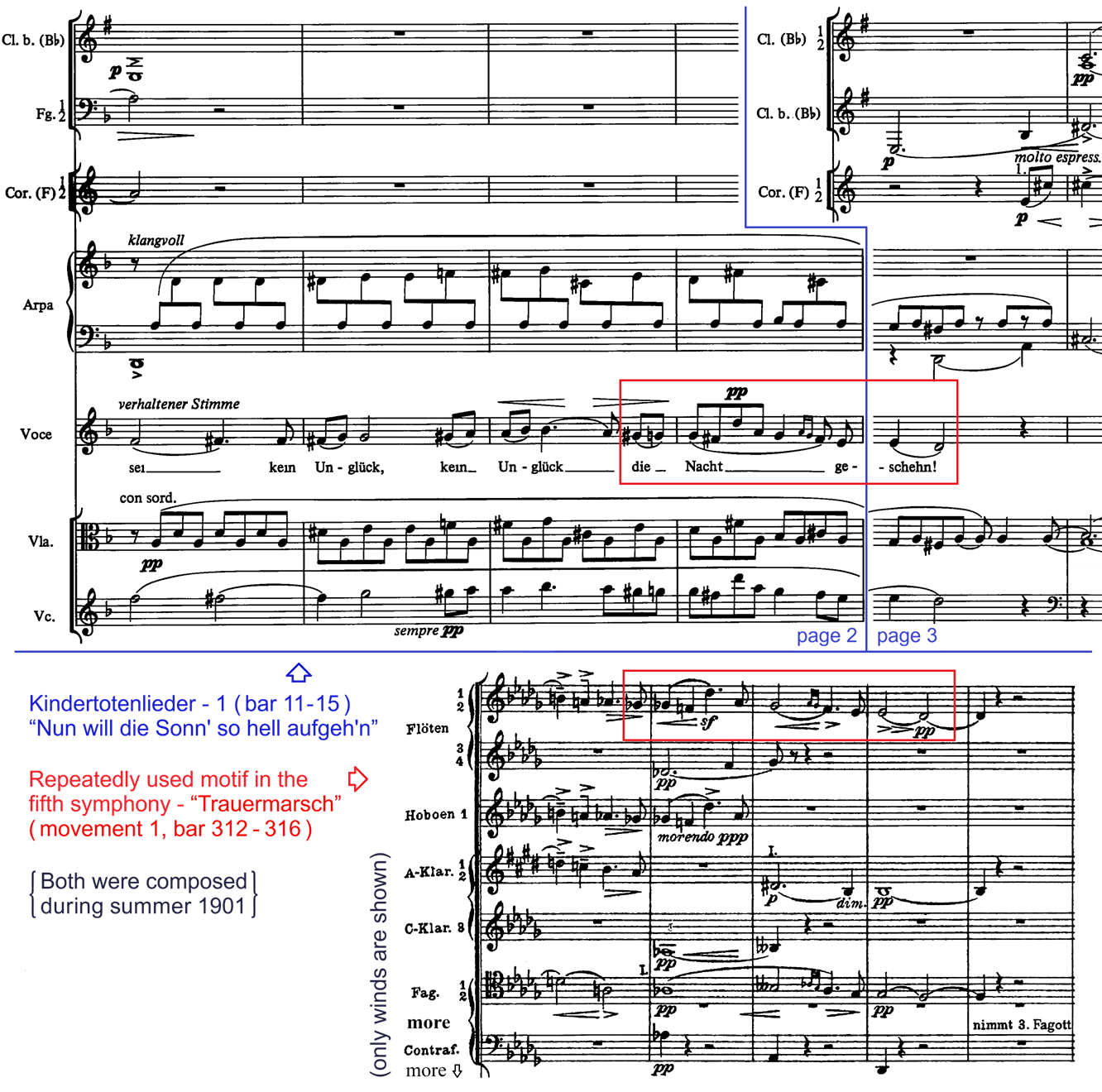
The song introduces (in the first and third person) a father having experienced a dreadful stroke of Fate, but in addition, it also reminds of brighter aspects of life. Coping with an unfavorable fate is set as the goal in this song as well as in the M5. Not surprisingly, a characteristic motif applied in the first, second and fourth stanza of the song is repeatedly quoted in the “Trauermarsch” with a thematic connection to the song’s themes. The following figure is composed a bit messy because the motif of interest is each time divided on two pages. The score of M5 is shown only for the winds, but here 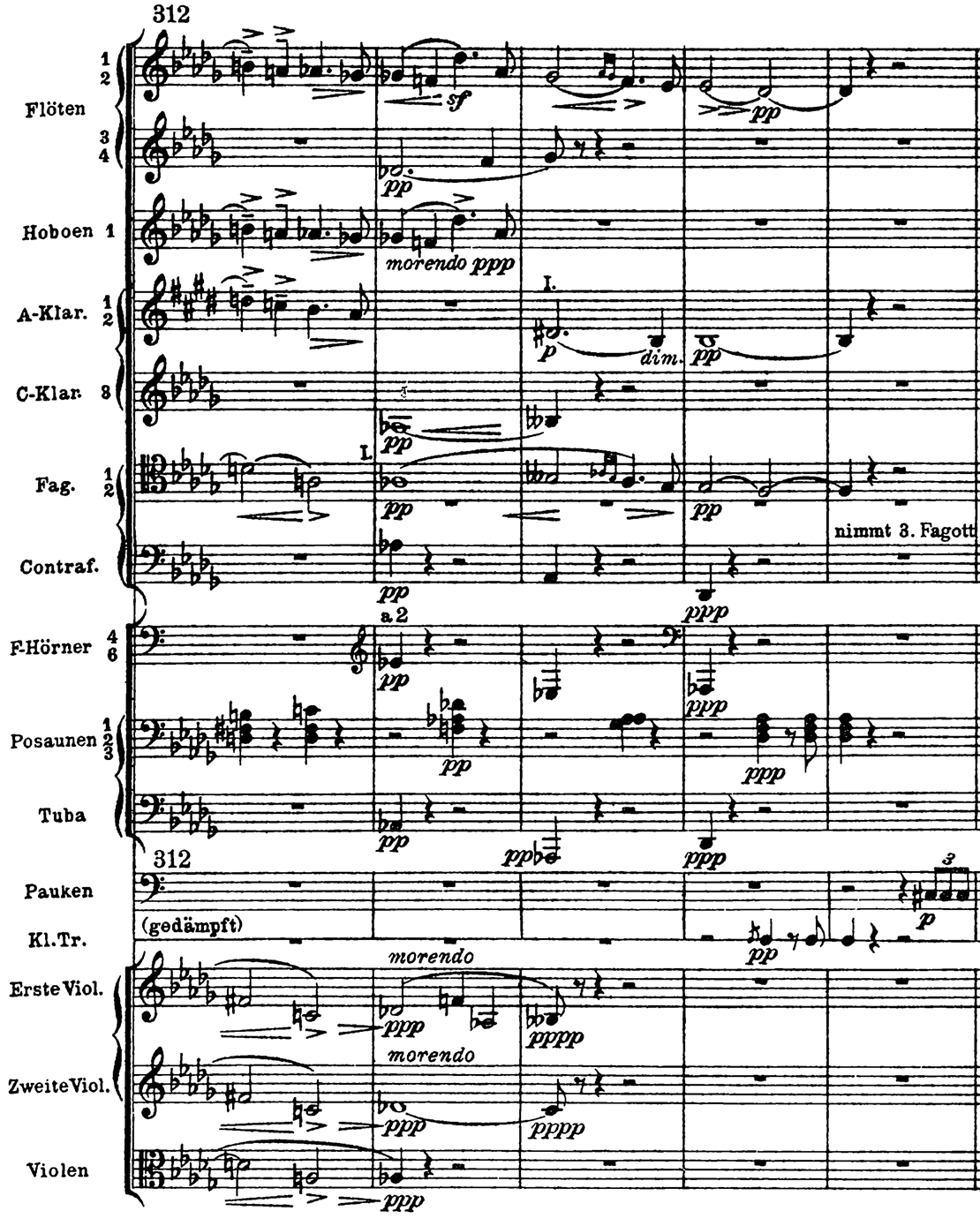 for the whole orchestra.
–
We must someday revisit this song – and respecting the Mahler’s request, together with the four following songs. I just add couple words about the voice or gender of the soloist. The author and composer were male, the third and fifth poems refer to mother from father’s point of view and Mahler collaborated with four baritones; no alto or mezzo-soprano as soloist for these songs. On the other hand, Bruno Walter preferred here the lowest female vocal ranges (contralto / alto / mezzo) and claimed that Mahler (in general) had similar preference – in contrast to Richard Strauss who preferred bright sopranos. Some scholars have even suggested that Mahler intentionally avoided underlining a gender point of view when composing for low female vocal ranges (e.g. in Das Lied).
I have excellent Kindertotenlieder recordings with baritones (Dietrich Fischer-Dieskau, Thomas Hampson, …), but for some inexplicable reason, I have grown a feeling that these songs are particularly well suited to female soloists. I also have a sneaking suspicion that I’m not the only one who thinks this way. General perception of women’s prominent role in childcare may have contributed to this idea, but it may also be simply due to the excellent performances with female soloists. In my case, Bruno Walter’s cooperation and praise for the legendary contralto Kathleen Ferrier has certainly affected as well.
“Nunn will die Sonn’ so hell aufgeh’n” split in four parts:
Anyway, I picked four favorites and ordered them according to the recording dates. The internet certainly offers us everything, but I refrain from violating copyrights and save your time by cutting my excerpts short, one stanza for each. No question, who shall begin.
S1 – Kathleen Ferrier, Bruno Walter, Vienna Philharmonic Orchestra, 1949:
–
S2 – Dietrich Fischer-Dieskau, Rudolf Kempe, Berliner Philharmoniker, 1955:
–
S3 – Christa Ludwig, André Vandernoot, Philharmonia Orchestra, 1958:
–
S4 – Janet Baker, Sir John Barbirolli, Hallé Orchestra, 1967:
“Ich bin der Welt abhanden gekommen”
During summer 1901 Mahler composed four other songs based on Rückert’s poems, including one of his most personal and characteristic vocal works: “Ich bin der Welt abhanden gekommen”. A signature song for 1901 and direct link to Part3 of M5 (1902). Let’s note it’s connection to the “Adagietto” through similarities in music (applications of the “Ewigkeit” motif) and focus in harp and strings. Some writers seem to have difficulties in accepting this song closely linked with the ‘Adagietto as a love song’. I have seen some assuming that the song depicts alienation from life and at least partial acceptance of death. It does not. The word “… gestorben” (dying) is written four times, but
- The poem belongs to the cycle “Liebesfrühling” (Spring of Love)
which Rückert wrote for his soon to be wife. - “gestorben dem Weltgetümmel” can be understood as
a lack of interest in the hustle and bustle of bourgeois Vienna. - The goal is set to living in eternal love and ‘in my song’.
Not so surprisingly, Mahler highlights “in meinem Himmel, in meinem Lieben” by his “ewigkeit” motif, as shown in my edited score extract 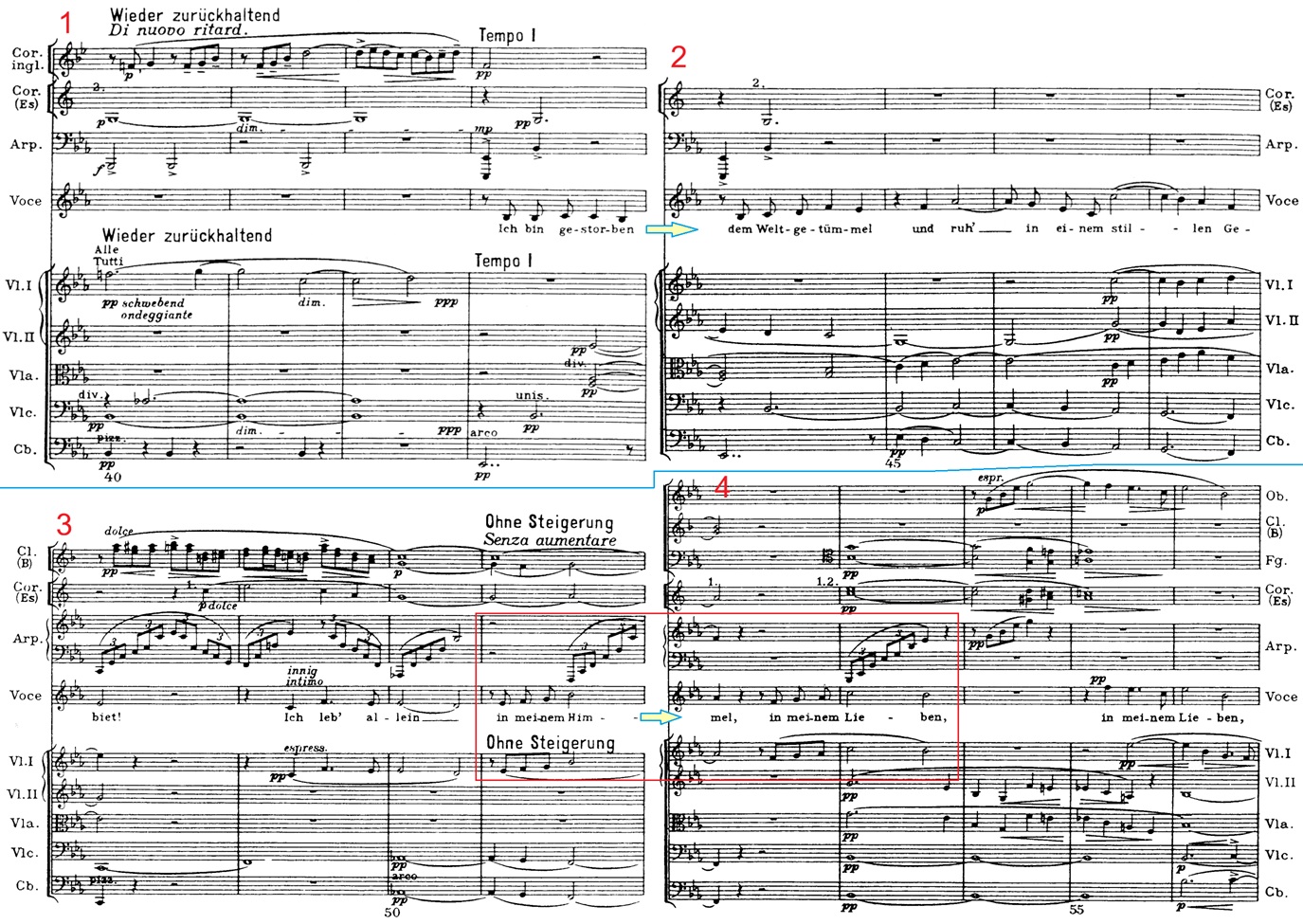 .
.
“Ich bin der Welt abhanden gekommen” does not belong to songs on misery and will be properly addressed in a separate posting, but I just wanted to recognize it in reference to the Adagietto of M5. The instrumental parts and former stanzas play essential role in this song, but I jump directly to the third and last stanza where the poets and composers daydream is brought in bright light – and invite Anne Sofie von Otter to sing it for us.
S3 – Anne Sofie von Otter, John Eliot Gardiner, NDR Sinfonieorchester, 1993:
As we ended this far, I still must express a wish for an upgraded translation of this Lied. I found five slightly different versions but in my opinion, none of the translations perfectly convey the message and atmosphere of the lied. When trying to write down my own interpretation, problems arise already on the title line which is commonly translated as “I am lost to the world”. I copied the title in English from the score and translated “abhanden” freely as “disconnected”, and so on. I ignored the Rückerts perfect lyrical meter (four lines in three stanzas) and even split the last lines (where Mahler already added repeats). Creating decent singable verses in English is certainly difficult, but some skilled poet could perhaps try.
| Ich bin der Welt abhanden gekommen
Ich bin der Welt abhanden gekommen, Es ist mir auch gar nichts daran gelegen, Ich bin gestorben dem Weltgetümmel Poem by Friedrich Rückert |
O garish world, long since thou hast lost me
I have become disconnected from the world, I couldn’t care less, I have passed from the world’s turmoil Translation based on the Lied |
I still want to suggest a couple of links for listening the song as a whole. With my deepest respect for Claudio Abbado, a recording from Lucerne Festival 2009 is a natural choice: Lucerne Festival Orchestra, Claudio Abbado, Magdalena Kožena (mezzo-soprano); Violin: Kolja Blacher & Cor Anglais: Emma Schied.
This also gives an excellent opportunity to remind of Jessye Norman as a devoted Mahler soloist, here with the New York Philharmonic and Zubin Mehta in the Lincoln Center in 1989. The video is not of best possible quality, but the performance is. The camera spends much time zoomed to her face revealing details in her art of emotional singing, in particular during the last stanza (from 4 min), but naturally best from begin.
Finally, Dietrich Fischer-Dieskau, the tall and great master with superb interpretation shall not be forgotten when writing of Mahler’s Lieds. His recording with Berliner Philharmoniker and Karl Böhm in 1964 was long my only favorite. A TV broadcasting with RSO Berlin and Riccardo Chailly in 1989 is unfortunately in quite poor video and sound quality, but brightly introduces his skills on stage with this song.