Mahler 1 – 3 – Totenmarsch in Callots Manier
Exploration of the Mahler’s first symphony continued
focusing on the third movement
Mahler composed M1 calling it “meine Symphonie” aiming to tell the story of his life in it. He wanted to reach and affect the audiences at a time when popularity of symphonic poems was growing. He was fully occupied with operas in the Leipzig ‘Neues Theater’ and didn’t have time for composing until the death of Emperor Wilhelm I (March 9th 1888). The opera was closed for a ten-day mourning time and Mahler drowned in composing which then continued in early mornings and late evenings along with the responsibilities in the opera. When completed, Mahler wrote to Fritz Löhr ‘I must get out and fill my lungs with fresh air. For six weeks I have seen nothing but my desk.’
A complete fiasco – three first performances
The result was a new kind of symphony, which also had features of an autobiographical tone poem. I’m certain that Leipzig would have been more favorable city for the premier, but for the next season the journeyman’s road continued to Budapest, where he was appointed director of the Royal Hungarian Opera. The symphony was first performed in Budapest November 20th 1889 titled as a symphonic poem in two parts:
Sinfonische Dichtung in zwei Teilen – Budapest 1889
Part I
– Einleitung und Allegro comodo
– Andante
– Scherzo
Part II
– A la pompes funèbres; attacca
– Molto appassionato
The audience in Budapest was conservative and deeply shocked, if not outraged, by the new kind of music. The performance was judged a complete fiasco and provoked hostile reactions from the audience and critics.
The symphony remained on the shelf for almost four years, until it was next time performed in Hamburg October 27th 1893 with slightly revised orchestration and titled as a tone poem in symphonic form:
“Titan”, eine Tondichtung in Symphonieform – Hamburg 1893
1. Theil
“Aus den Tagen der Jugend”, Blumen-, Frucht- und Dornstücke
I “Frühling und kein Ende” (Einleitung und Allegro comodo)
II “Blumine” (Andante)
III “Mit vollen Segeln” (Scherzo)
2. Theil
“Commedia humana”
IV “Gestrandet!” (ein Totenmarsch in “Callot’s Manier”)
V “Dall’ Inferno” (Allegro furioso)
The third performance was part of the following annual meeting of the Allgemeiner Deutscher Musikverein, June 3rd 1894 in Weimar with reduced orchestral and rehearsing resources among a long program. The ‘Titan’ was now a ‘Symphony’. The descriptive names for the last movements were amended for the
Symphonie “Titan” – Weimar 1894
IV Des Jägers Leichenbegängnis, ein Totenmarsch in Callots Manier
V Dall’ Inferno al Paradiso (Allegro furioso)
A critic of Berliner Courier reported that Mahler had published the movement notes ‘reluctantly, on the advise of his friends’. Mahler himself explained that the notes had been given because ‘I intended them only to assist the listener along some general path of fruitful reaction’. After Weimar Mahler removed the title ‘Titan’, ‘Blumine’ movement and all notes addressed to the public. However, when attending a concert or buying a CD, we often get at least part of these explanatory notes:
Symphonie “Titan”
– From the Days of Youth, Pieces of Flowers, Fruit, and Thorns
Part I
- Spring and no end; the awakening of nature in the forest in the earliest morning.
- Under Full Sail
Part II
- Funeral March in the Manner of Callot; The Hunter’s Funeral Procession
- Dall’ Inferno al Paradiso (From Hell to Paradise);
as the sudden outburst of despair from a deeply wounded heart
A complete fiasco – why?
Actually, the performances on Hamburg and Weimar were not complete fiascos, rather sharply dividing the audiences. Partial acceptance in Hamburg was encouraging, but a disappointment among colleagues in Weimar. Mahler was expecting better responses, especially from Richard Strauss, who had helped him in getting M1 in the festival program.
Why was there so notable contrast between the first and second performances? It has been suggested that Hans von Bülow might have indirectly affected the atmosphere in Hamburg. He had conducted the premieres of Wagner’s “Tristan und Isolde” and “Die Meistersinger von Nürnberg” and had a fame as a champion of new music. Probably true, but I dare to suggest that Bülow was not the only reason.
The very negative reaction from the public in Budapest had been explained by the fact that they were not offered any explanation of the story line. But perhaps they got angry precisely because they understood too well. The first part provided new kind of music and surprises, but was certainly interesting or at least bearable. It was the funeral march and perhaps also the subsequent loud outcry of despair in opening of the final movement which crossed the line. This was reported by August Beer in the Pester Lloyd newspaper:
‘ The reception of the Symphony was as divergent as the two halves of the work. Our concert audience … listened with alert interest to the first section, … After the Death March the mood changed, and … ’
The first part was concluded in positive energy under full sail or according to August Beer’s impression, among dancing villagers. Now, our ‘anti-Titan’ protagonist faces another reality among ordinary people despising other people’s religions and singing mockery songs. I believe that Mahler wanted to hit back and did it so hard that he found it later necessary to provide even misleading hints on the inspiration behind the third movement.
Frère Jacques – Bruder Jacob – Bruder Martin
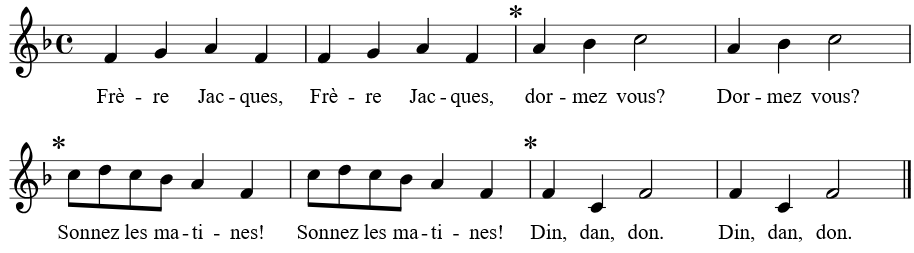
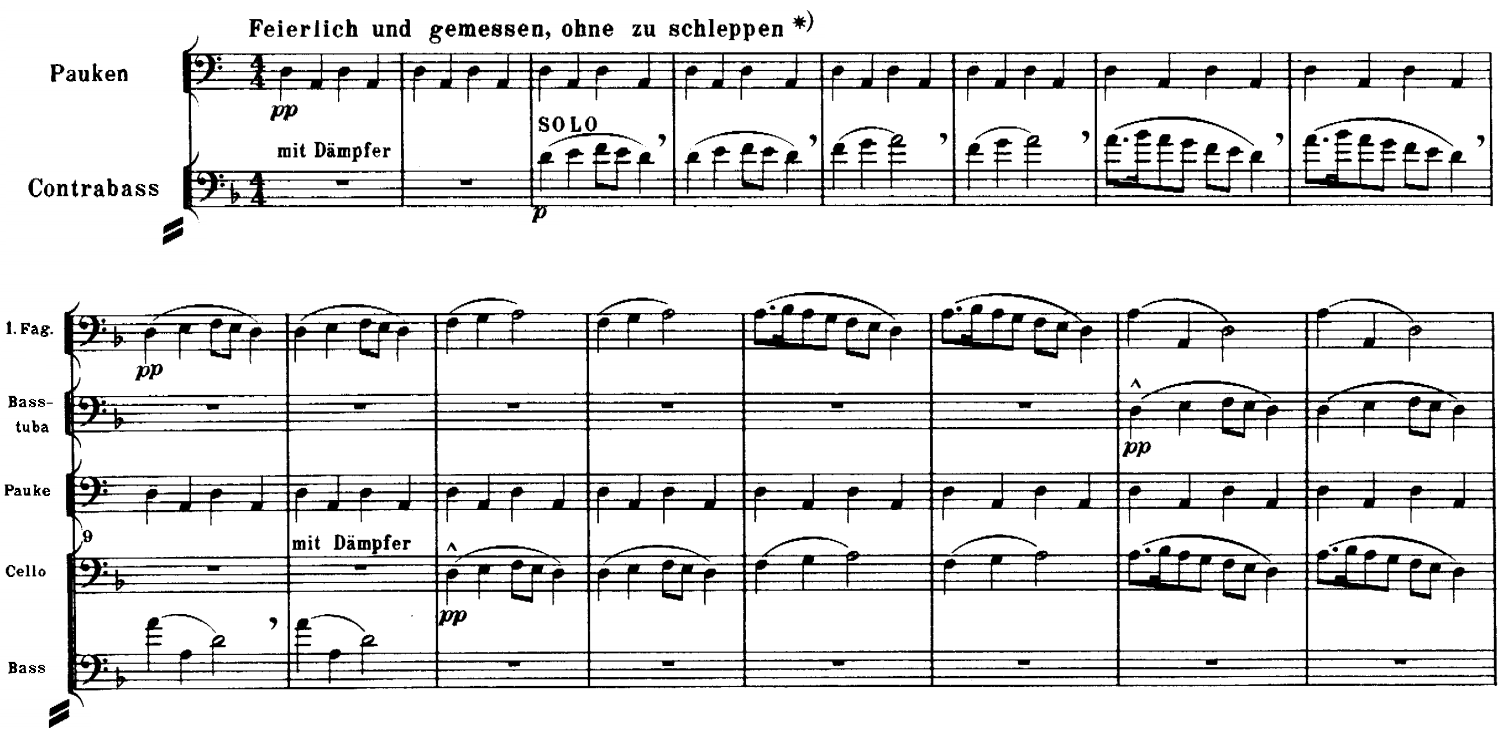
Frère Jacques is known as a most famous canon song for children throughout the world, Figure 2. It is translated to at least 64 languages. Mahler expanded the list of languages by ‘Callots Manier’ and minor key. He transferred the song to a twisted instrumental canon for a symphony orchestra, Figure 3.
–
–
The third movement ‘Funeral March in the Manner of Callot’ begins with the two note “Naturlaut” motif by timpani which will continue accompanying the canon for long. At Mahler’s time one could not expect that a double bass player would play a beautiful solo. That was neither Mahler’s intention, when he invited the bassist to begin the march of the street band at muted high notes. I think the bassist of the Columbia Symphony Orchestra instructed by Bruno Walter does a good job still in 1961:
Opening of the third movement by Columbia Symphony Orchestra, Bruno Walter, 1961.
The bassoon, cellos and bass tuba and clarinet joined the canon after the bass solo. The clip stops at bar 18, just before the oboe provides an observing bird’s point of view, violas join the canon, and so on … This all is naturally best observed in Areena. The third movement begins at 26 minutes in the latest RSO recording (before Friday). Direct link to: begin of M1-3 [RSO – Tabita Berglund 2023]
Bruder Jacob – a nursery song?
“Frère Jacques” and its international variations are known as one of the simple canons that most children around the world sing in kindergarten or school. It was listed among 86 canons authored by Jean-Philippe Rameau (1683-1764), but it probably has older roots.
The French song concerns a friar’s duty. It is time to ring the bells for morning prayer (matines). Frère Jacques has overslept and we wake him up with this song. A wake-up song is perfect for nursery use but it seems that the canon was originally created to mock the Dominican monks. If so, “Frère Jacques” was a monk at the Église Saint-Jacques du Haut-Pas chapel in Paris:
Brother Jacques, Brother Jacques,
Are you sleeping? Are you sleeping?
Ring the morning bells! Ring the morning bells!
Ding, daing, dong! Ding, daing, dong!
In Finland, “Jaakko kulta” follows the the story of the French song: “Herää jo! / Kellojasi soita!”, but the traditional English and German lyrics deviate from a direct translation. Instead of ringing the bells himself, John, Jakob or Martin should hear the bells (and join the morning prayer):
Are you sleeping? Are you sleeping?
Brother John, Brother John,
Morning bells are ringing! Morning bells are ringing!
Ding, dang, dong. Ding, dang, dong.
Bruder Jakob, Bruder Jakob,
Schläfst du noch? Schläfst du noch?
Hörst du nicht die Glocken? Hörst du nicht die Glocken?
Ding dang dong. Ding dang dong.
Two versions of the canon became popular in catholic regions of Austria-Hungary and Germany. ‘Bruder Jacob’ addressed Jacob, the Jew and ‘Bruder Martin’ addressed Martin, the Lutheran Protestant. Both of them missed the catholic morning services and deserved to be ridiculed in the canon. Although Mahler was not spending much time in beer halls, it is obvious that he knew exactly the meanings of those popular mockery songs.
{{A further question arises whether “Frère Jacques” was included to the professional farter Le Pétomane’s repertoire at the Moulin Rouge in 1892. If Mahler had read or heard about this, might he have gotten the idea to parody the song from a famous flatulist?}}
In any case, Mahler got an idea to construct a grotesque parody of the anti-antisemitic mockery and insert it to his autobiographic symphony to illustrate how the protagonist faces offensive and ugly reality among ordinary people. Mahler referred to ‘Bruder Martin’ as the melody source, but I think he was just distancing and generalizing the story from his own anti-antisemitic experiences.
This ‘Bruder Jacob’ parody must have irritated the anti-Semite section of the audiences. Adding some taste of schmaltz, glissando and klezmer dances didn’t much help; neither the ‘oom-pah-pah’ by a poorly playing street band:
Concertgebouw ‘oom-pah-pah’ street band led by Leonard Bernstein, Amsterdam 1987.
It is easy to understand, why the mood changed after this movement in the Budapest Vigadó Concert Hall. Budapest was not an ideal place for this provocative move which Mahler tried to downplay afterwards. Religious affiliations in Budapest were 65% Catholic, 21% Jewish, 7% Calvinist and 6% Lutheran. The next performance in Hamburg was not perfectly, but much better received. Potential effect by Hans von Bülow was mentioned above, but the fact that Hamburg was within the northern Protestant part of Germany may have helped even more. Weimar was also within the protestant region, but the festival participants may have arrived from different regions. It is also possible that the colleagues paid attention to other unconventional aspects in the symphony.
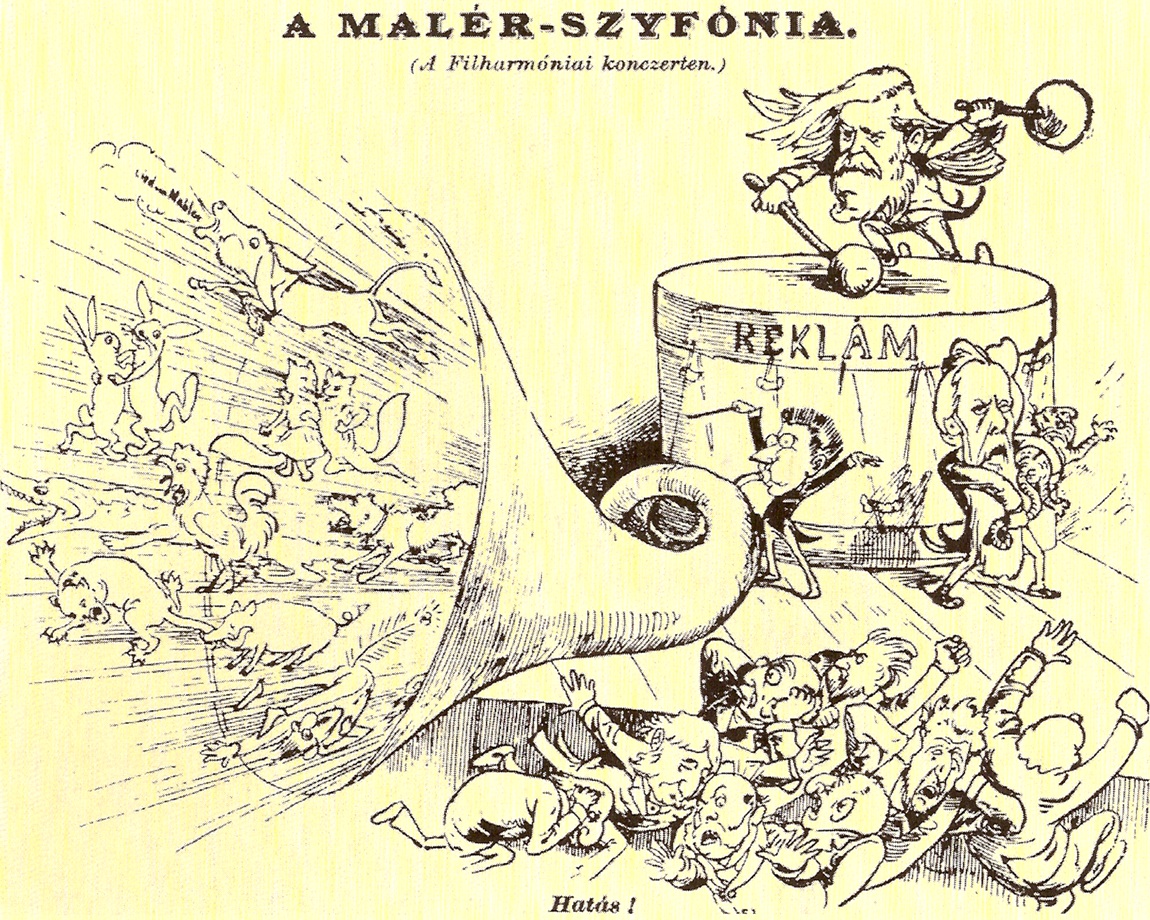
During his ten year tenure in Vienna, Mahler conducted M1 only once (November 18th, 1900). The cartoonist’s feedback had a similar attitude to that in Budapest, and was probably a fair description of a good share of the reception among the audience in Vienna:
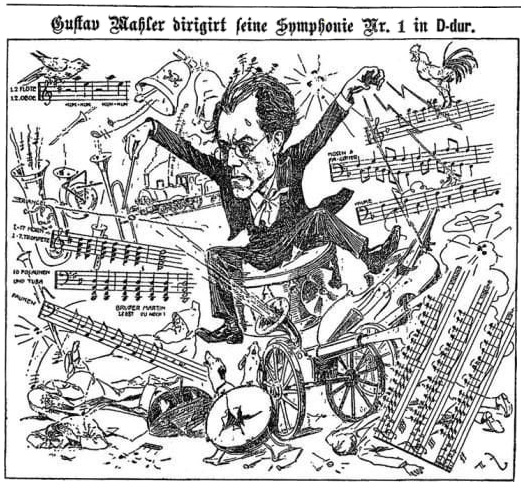
Die zwei blauen Augen
The third movement is actually built of two Funeral Marches, which go to a ‘fake graveyard’ and back. The destination is actually a linden tree, where the music turns subdued and gentle (in major between the marches in minor) featuring the song “Die zwei blauen Augen von meinem Schatz” (The Two Blue Eyes of my Beloved), the last of Mahler’s “Lieder eines fahrenden Gesellen”. The first song described the Gesell’s feelings when his Beloved was in her wedding with somebody else. The last song leads the repressed wanderer to “rest in peace” under a blooming linden tree. The blue eyes send him gently away – in this symphony between grotesque funeral marches: Die zwei blauen Augen [M1 by RSO, Tabita Berglund 2023].
Des Jägers Leichenbegängnis?
For the Hamburg premier Mahler named the third movement as “ein Totenmarsch in Callot’s Manier” (Funeral March in the Manner of Callot). Ferdinand Pfohl, music editor of the Hamburger Nachrichten claimed that he had suggested this subtitle in order to underscore its grotesque and bizarre character [LG-GM, vol.1, p. 543]. I believe that this subtitle was a genuine afterthought in line with Mahler’s inspiration or state of mind while composing, but the amendment for Weimar I cannot buy. I rather believe that the subtitles, at least the latter one (The Hunter’s Funeral Procession), was aimed to calm down the anger raised. Mahler and his friends certainly understood what happened in Budapest. It may have even affected acceptance of Mahler’s own music for rest of his career, especially in Vienna.
A lot has been written on Mahler’s inspiration for the third movement. He left us conflicting notes and comments on the matter; once stating that there was no extra-musical idea, another time referring to Jacques Callot’s graphics, then naming a drawing ‘Wie die Tiere den Jäger begraben’ by Moritz von Schwind as a source of his inspiration. The secret meaning of this grotesque music was finally revealed, ‘a nursery picture of animals in a funeral procession’ :
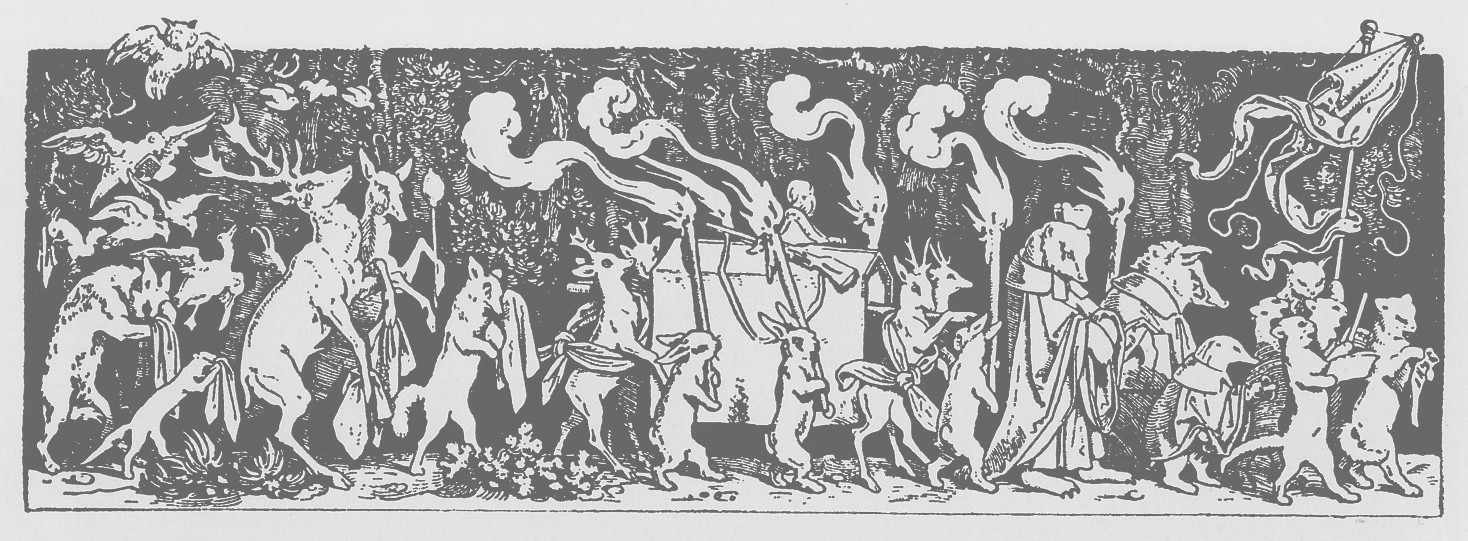
The concert program notes, and practically all Mahler studies consistently suggest that we believe this story, sometimes even that Mahler had mistakenly attributed the von Schwind’s wood-cut for children as a work of the famous printmaker Jacques Callot. I do not believe it. Jacques came before Moritz and fits in the autobiographical story-line, Moritz does not. Let me shortly introduce my hypothesis on
Inferno in Callot’s Manier
I suspect that Mahler finally managed to fool the critics and audiences on his inspiration behind the Funeral March. Let’s hope that this trick succeeded in mitigating the irritation aroused in the audience, at least for some part. A reference to Moritz von Schwind’s drawing seems to have done good job in that. And by not removing the reference to Callot (until removing all notes for the public) he maintained the hard line of expression, which we will study next.
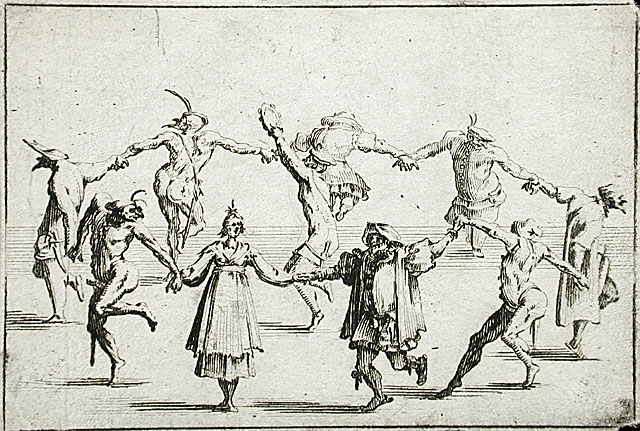
Jacques Callot (1592 – 1635), a pioneer of etching and copper engraving, was known for his grotesque subjects depicting misery and misfortune, especially in ‘Les Misères et Les Malheurs de la Guerre’ (The Great Miseries of War), which illustrates the destruction unleashed on civilians during the Thirty Years’ War (1618 – 1648), one of the most destructive conflicts in Europe and religion as an important factor in starting the war. Callot’s production also included a large collection of grotesque musicians and dancers. Remembering that Mahler studies in Vienna University included history of arts, he certainly paid respect for Callot’s pioneering works.
Isabelle Werck studied potential links between arts of Callot and Mahler. Her summary in ‘Revue Musicale de Suisse Romande, 2003’ pointed out how Mahler was charmed by the mixture of naivety and wisdom in the German folk poems in ‘Des Knaben Wunderhorn’ collection. She concluded that three of the 24 poems composed by Mahler were rooted to miseries of wars, which was an important subject for Jaques Callot. According to her, the songs potentially affected by Callot’s prints were Revelge, Der Tamboursg’sell and Zu Strassburg auf der Schanz – with symphonies 6 & 7.
Edwin De T. Bechtel had recognized Mahler’s quotation and wrote four interesting lines in his book on Callot. He suggested: “Perhaps Mahler, in this ironic, macabre music, had in mind Callot’s Temptation of St. Anthony” [Edwin De T. Bechtel, “Jacques Callot”, © G. Braziller, New York, 1955].
This is getting really macabre now, but also interesting.
Temptation of St. Anthony
Callot prepared two versions of this subject (1617 & 1635). The first one seems to fit better in the current context. It is a wide, ironic and macabre scenery, where St. Anthony the Great is positioned hardly visible back on the other side of the river. In front, tired, fully exhausted soldiers are slowly marching in a procession, while many animals and odd creatures are playing musical instruments. Several ill-behaving groups dance and play everywhere, Figure 6:
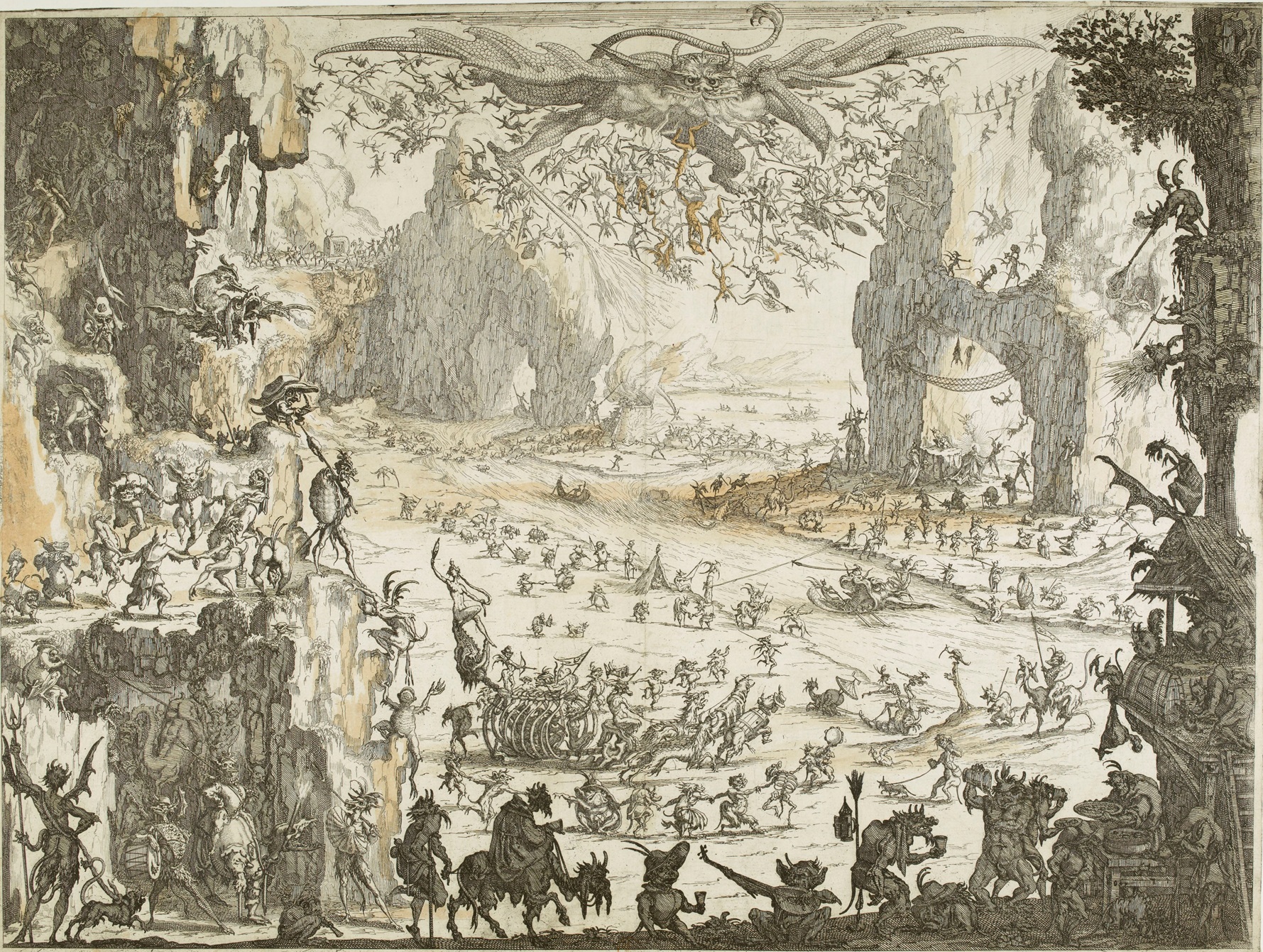
It seems that we have no confirmed knowledge on Mahler’s thoughts when he released the subtitle “ein Totenmarsch in Callot’s Manier”, but I could imagine that Edwin De T. Bechtel actually hit a plausible point. The tired, fully exhausted soldiers in front might be marching to the beat of the ‘Bruder Jacob’. The drum player is just stepping out of the cave and there are plenty of dancing groups, some cheering round the horses pulling a skeleton of a large animal – in kind of a totenmarsch? Furthermore, the protagonist visiting the ‘Inferno in Callot’s Manier’ might have feelings similar to St. Anthony in this picture.
But as we have no proof, this remains a hypothesis. I add here links to a few different examples of “music in Callot’s Manier”. A less grotesque compromise could perhaps be based on them, if the Anthony’s point of view is too brutal. The Moritz von Schwind’s funeral march graphic, where animals are carrying a dead hunter to the grave, is still a good choice for program notes when M1 is played for kids, but …
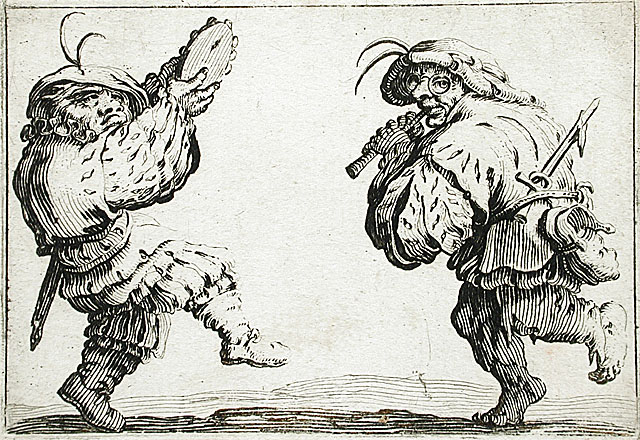

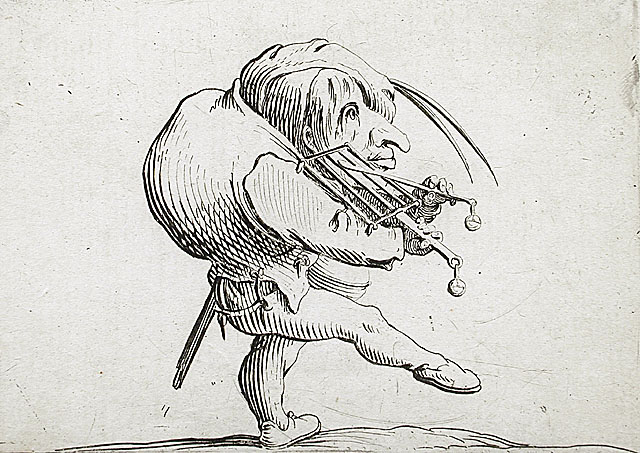
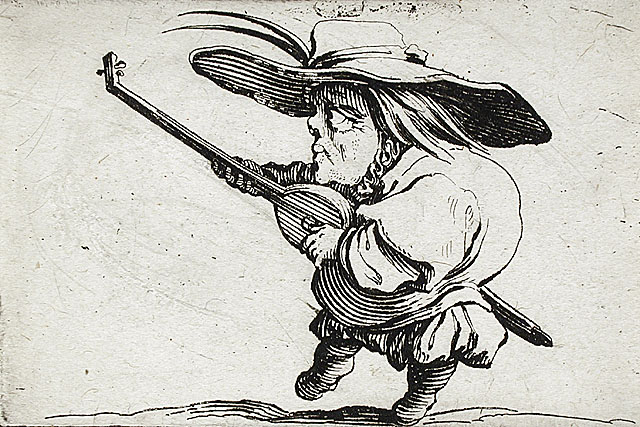
Dall’ Inferno al Paradiso
The (temporary) subtitle for the finale confirms that we are coming from inferno. The third movement began with hardly audible ‘Naturlaut’ motif repeated by Timpani and fades similarly to silent darkness with Timpani & bass, finally pp capped by big drum and bass. Meanwhile, the conductor and rest of the orchestra are already gearing up in preparation for the loud outburst:
First 24s of M1 Finale “Stürmisch bewegt”; Concertgebouw Orchestra, Riccardo Chailly, 1995.
In 1901 Mahler wrote: ‘the third movement … is heart-rending, tragic irony and is to be understood as exposition and preparation for the sudden outburst in the final movement of despair of a deeply wounded and broken heart.’ The Finale is then reporting how the protagonist is striving on road towards the paradise. There are still lessons to be learned and many in the audiences (including Richard Strauss in Weimar) have thought that Mahler could have capped the finale at an earlier point, but Mahler thought that a ‘false ending’ was essential to demonstrate how the protagonist must continue to climb beyond a peak which once had seemed to be the final goal.
Mahler often used a wording “Applause streibend” in a less appreciative meaning when commenting music tuned for secured popularity. M1 was not the only one of his works, which had little risk of entering to that category at his time. But no doubt, this Friday the RSO 2025-2026 season will be closed “Applause streibend”.
Here is a direct link to the first part: “Mahler 1 – 1 – Reminiscences of a wandering apprentice”