
Mahler 1 – 1 – Reminiscences of a wandering apprentice
This posting will focus on the first movement of M1 – linked with the song which provided its main theme. In a separate posting “Mahler 1 – 3 – Totenmarsch in Callots Manier”  I will report about my deep dive into the third movement. That story is broad and emotionally deep, perhaps even appalling for some readers. You might rather check this link “M1 at gustavmahler.com” and find there a professional analysis of M1 as a whole (with nursery-compatible inspiration explained for the Funeral March).
RSO played M1 previous time in 2023 [RSO – Tabita Berglund 2023]
HKO in 2025 [HKO – Anja Bihlmaier 2025] (M1 begins at 56:50) .
See the listing of earlier RSO recordings in the Areena .
But let’s begin from the begin and childhood:
Awakening at dawn
“What! – Is this music?” This kind of questions must have been raised in many minds when the first performance of M1 began. Probably still 136,5 years later, May 29th 2026 when Nicholas Collon and RSO start to play.
All strings begin together, each playing a quiet constant note and continue for about four minutes (1/4 of the movement) before picking up any melody to be played. Meanwhile, the winds provide simple notifications and short passages. The mystically lingering atmospheric background provided by the strings has been suggested to represent ‘a sound of silence’, if silence could be heard. In Mahler’s childhood, it was possible in the early mornings. ‘A clear night sky lit by stars’ might be even a better notion.
The winds introduce simple sounds in slow pace until we hear the morning wake-up call at the soldiers’ barracks (200 meters from his home). For M1, the trumpets shall be positioned at a far distance “in sehr weiter Entfernung aufgestellt”. We’ll see (or hear) where RSO places these this time. In previous M1 concerts they have been out of sight, e.g., [RSO – Tabita Berglund 2023].
It seems that Mahler is describing here memories of nature experiences in his childhood. A famous anecdote fits perfectly here. Gustav had been in the forest with his father, who asked the boy to wait at the place while he had to do something and forgot him there for some hours. When the father finally returned, he found Gustav sitting on the same spot enjoying and absorbing ‘Naturlaut’, to be used in M1 and many other works. Mahler claimed it to be the soul of all his symphonic works. In a letter to Natalie Bauer-Lechner he also wrote: ‘Composing is like playing with building blocks, where new buildings are created again and again, using the same blocks. Indeed, these blocks have been there, ready to be used, since childhood, the only time that is designed for gathering.’
Naturlaut
The meaning of ‘nature’ was broad for Mahler. He explained how the third symphony depicted evolution from inorganic earth to living beings, from man to divine love and angels, and “it is hardly music anymore, just the voice of nature – Naturlaut”. Fortunately, we can find a less complex view of the ‘Naturlaut’ at begin of M1. Here is the first page (it opens in a new window by clicking on the image):
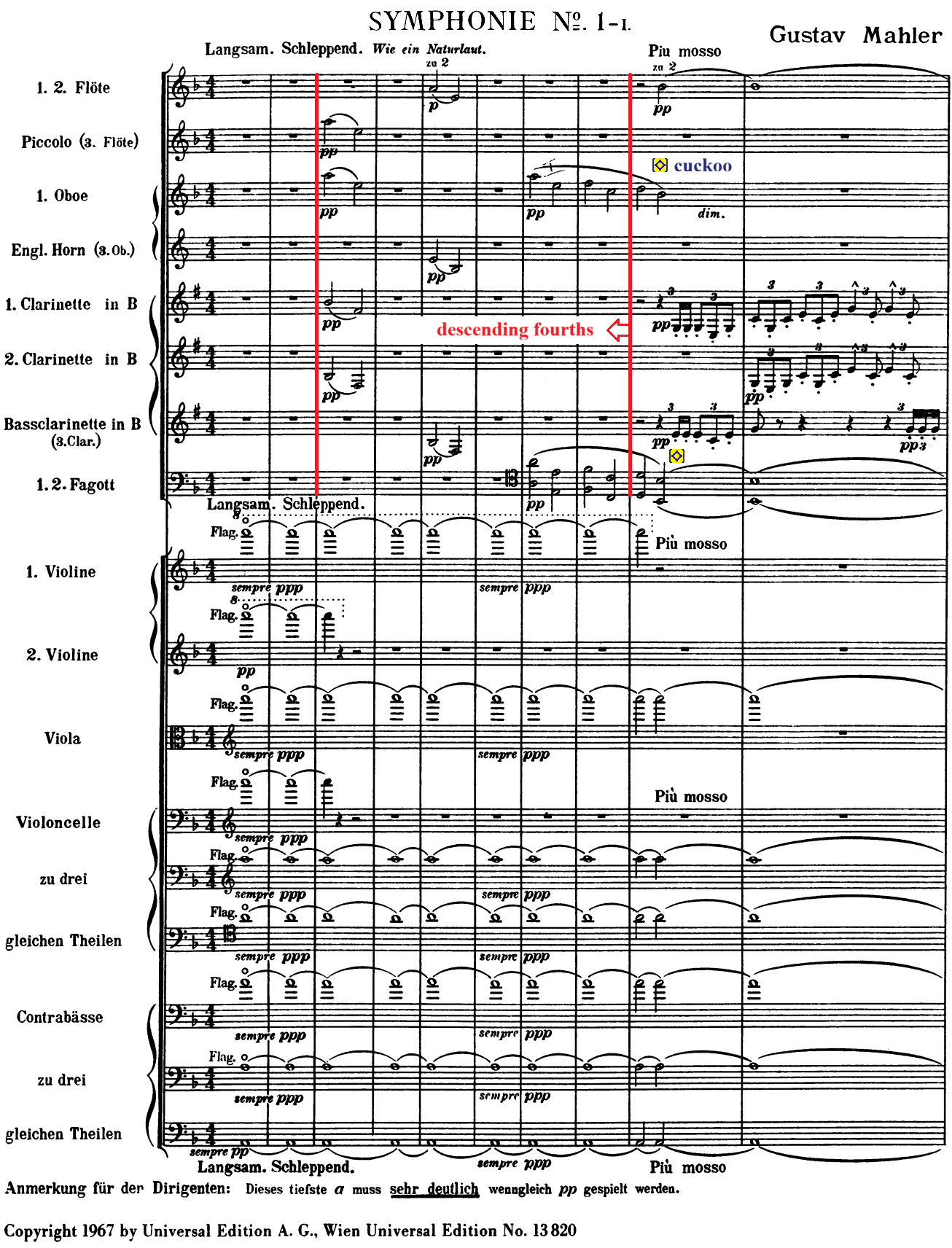
The score begins with instructions: “Langsam. Schleppend.” ; “Wie ein Naturlaut” – (Slowly and leisurely ; as if spoken by nature). The bottom of the page shows how all the strings play constant notes, the cellos and basses divided in three even sub-groups. A closer look reveals that all are playing ‘A’ notes and create a seven-octave drone on A. During bars 3 to 8, the winds introduce a two-note ‘descending fourth’ motif, which will be used through the symphony. Shorter ‘drone resembling’ passages will also be re-played; the finale begins with winds and horns playing (about) constant notes on background of wild playing strings.
Not much happens and everything very slowly and quietly. Playing this first page took about a minute for the Concertgebouw Orchestra with Riccardo Chailly [May 1995; DECCA 448 813-2]. I amplified the very low volume to 250%:
A bit later the clarinet is instructed to play the ‘descending fourth’ motif simulating the rhythmic cuckoo’s call “Der Ruf eines KukKuck nachzuahmen”, which leaves no doubt of the reference in real forest – though it is an incorrect imitation. A direct quotation to cuckoo would require a ‘descending third’ (as in Beethoven’s 6th symphony) and a lower pitch. But this is not a ‘pastoral symphony’. The clarinet plays “Naturlaut” – nature re-composed:
For comparison, here is a cuckoo recorded by Janne Bruun in a Finnish forest:
–
A graphical comparison and Mahler’s instructions for the clarinet’s call are shown in Figure 2:

The ‘Naturlaut’ introduced in the first movement was new kind of music though it actually utilized notable references to Beethoven and Brahms. Even the selection of three soloists birds – cuckoo, quail and nightingale – matched with set of birds in B6.
Ging heut’ morgens über’s Feld
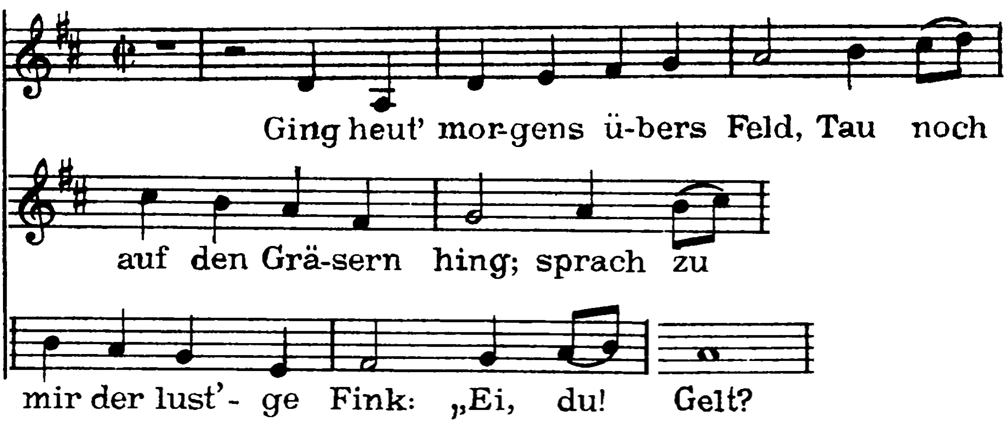
Mahler had a good reason to start the symphony by introducing the ‘descending fourth’ motif instead of realistic cuckoo calls. The ‘descending fourth’ was needed, because Mahler wanted to ‘copy paste’ his ready-made song “Ging heut’ morgens über’s Feld” from the ‘Lieder eines fahrenden Gesellen’ (I went this morning over the Field / Songs of a Wayfarer). The song begins with a ‘descending fourth’:
–
The first lines of the poem and melody of the song are shown in Figures 3 and 4. The melodies of the song are widely referred and further developed in the first movement of M1. Figure 4 shows a section where the cellos introduce the vocal line of the song just as in the song. The melody for the first line of the song can be found also on the lines for bassoon and trumpet in Figure 4. The score parts can be opened for reading by clicking the pictures.
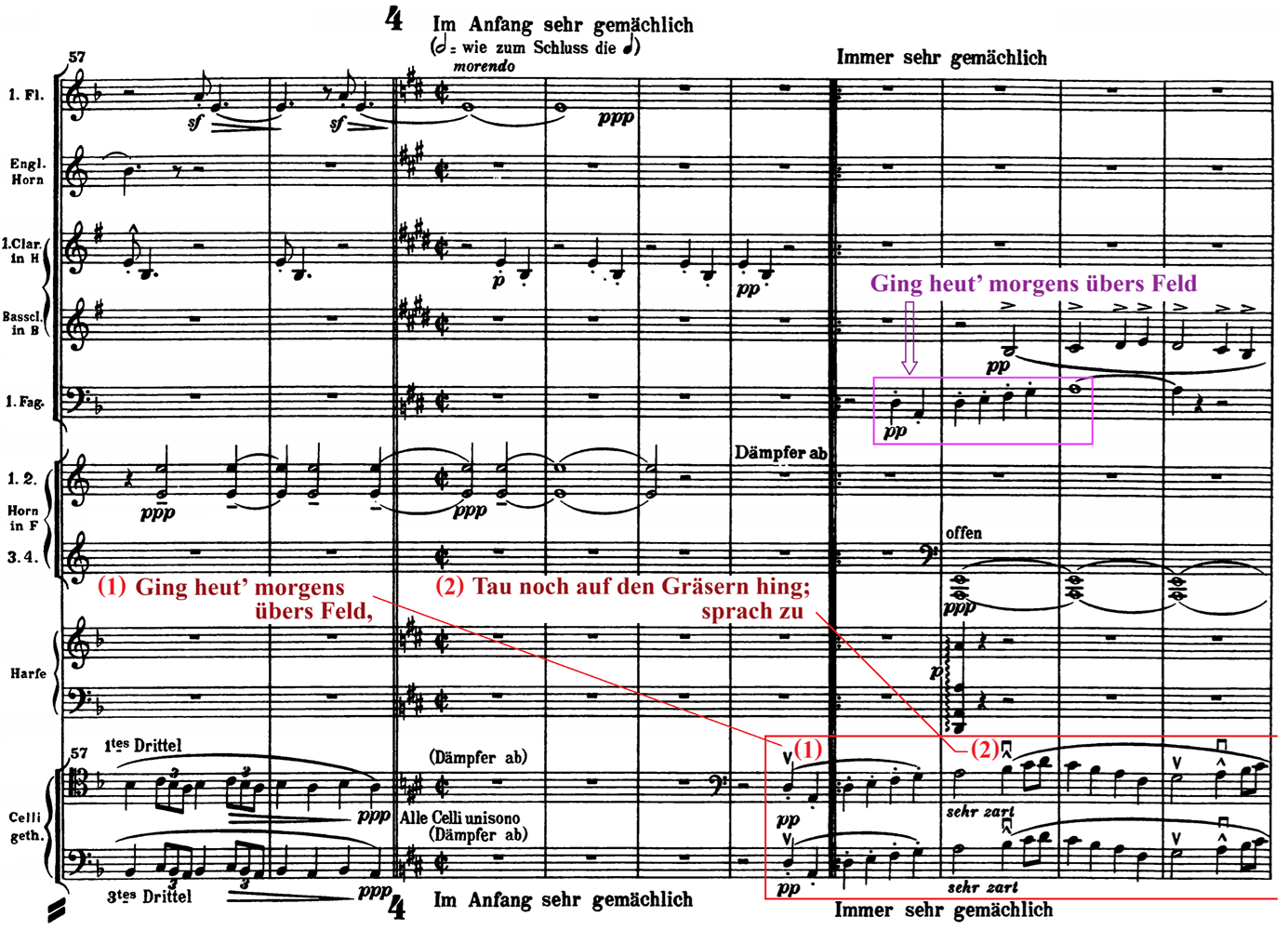
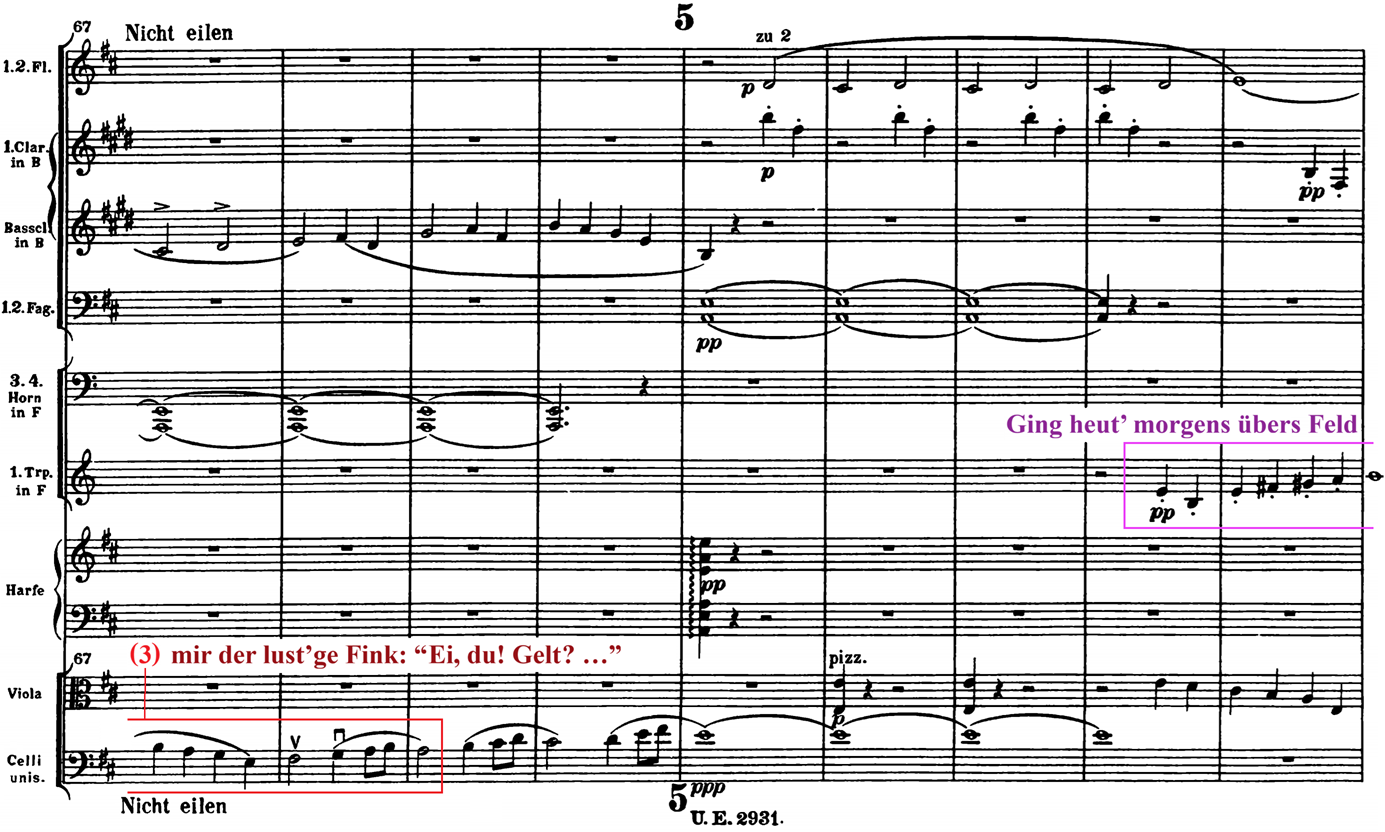

This example introduces the cellos singing among the sounds of nature. It begins from bar 57 (Figure 4a). The Concertgebouw Orchestra is conducted by Riccardo Chailly in a recording from May 1995 [DECCA 448 813-2]. Low volume is again amplified to 250%.
Morgen -/- morgens ?
By the way, I find everywhere the title and words of this Lied written – and also vocalized – as “Ging heut’ Morgen …” though Mahler wrote it: “Ging heut’ morgens …”. One may say that the difference is minor, but I wonder why Mahler used the “morgens” form. A closer look in the original manuscript confirms that “morgens” in Figure 3 is not a printing error:
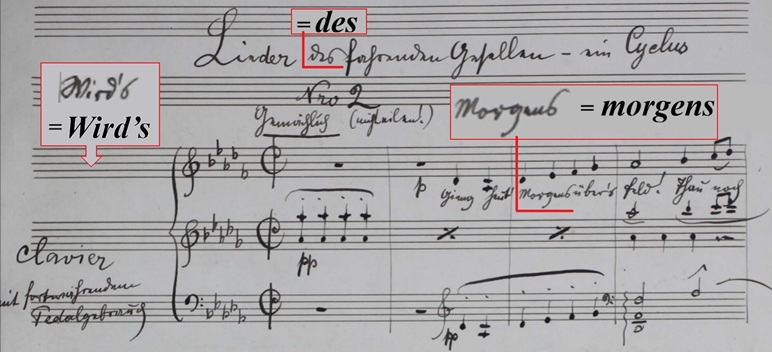
Mahler’ s handwriting looks a bit personal and introduces “s” in different styles. This can be seen on the title line “Lieder deS fahrenden Gesellen – ein CycluS” in Figure 5, but just similar “s” can be found repeatedly in the manuscript. At least three times on the same page for “des”, “Wird’s”, “morgens”. This leaves to me no doubt on Mahler’ s original intention. Who, when and why changed the “morgens” to “Morgen” ? I leave it for the singers or scholars to explain.
The manuscript reveals also an interesting ambiguity in naming of the work. The front page of Mahler’ s manuscript names this set of songs as:
– Geschichte von einem “fahrenden Gesellen” in 4 Gesängen
– (Story of a “wandering apprentice”)
On top of each song, the set is named:
– Lieder des fahrenden Gesellen – ein Cyclus
– (Songs of the “wandering apprentice”)
An autobiographic set of songs? Not really, but perhaps much of his feelings embedded in the texts and melodies.
–
Reminiscences of a wandering apprentice
After the studies in Vienna Conservatory and University, Mahler became indeed a ‘fahrende Gesell’, a journeyman wandering round as an apprentice on his way to became a supreme opera conductor and director in Hamburg, Vienna and New York. The songs focus much on disappointments in love. The young Mahler had some hopes and rejections, starting with a hometown girl, who’s family disapproved him. Our wandering apprentice had written these poems in Kassel for Johanna Richter, a soprano who could not accept falling in love with the young choirmaster and conductor. She wasn’t the only one who wasn’t ready to give up her career as an opera star for a marriage. Mahler became interested in the musicians who were able and aiming for a tough career, but relationships between the staff members were not allowed.
The topics of the first and last songs are much telling: 1) “Wenn mein Schatz Hochzeit macht” (When My Sweetheart Gets Married); 4) “Die zwei blauen Augen von meinem Schatz” (My sweetheart’s blue eyes). The last song leads the repressed wanderer to “rest in peace” under a linden tree. In the third movement of M1 its melody is played between the two funeral marches at the turning point of a procession going back and forth.
After writing and composing his story of a “wandering apprentice”, Mahler’s career has progressed and led him via Prague to the famous Leipzig Opera as the second conductor. Not a young apprentice any more, but still on the road and without a spouse. In addition to the second and last songs of the “wandering apprentice”, Mahler included into M1 a full movement (serenade type “Blumine”) inspired by Johanna Richter in Kassel. The “Blumine” did not fit well to the symphony and fortunately Mahler removed it himself from the symphony.
Mahler insisted that M1 wholly explained his own life (that far). It starts with awakening of the Naturlaut for a young boy early in the morning and continues into the years of wandering and learning of life as a ‘fahrende Gesell’ (apprentice or journeyman). Therefore, I suggest that the subtitle “Reminiscences of a Wandering Apprentice” would be more appropriate for M1 than the “Titan” commonly used in recordings and program notes.
The subtitle ‘Titan’ is misleading the audiences. The Johann Paul Friedrich Richter’s capital novel “ Titan ” was among Mahler’s favorites, but it is not among the best-sellers in 2026 and this title is secured to divert our thoughts elsewhere. The Richter’s story centers on education and moral development of Albano de Cesara along his journey and transformation from a passionate youth into the mature man. The philosophical struggles of the 18th century and the conflicts between idealism and reality are explored through divergent and idealized secondary characters. The main character Albano represents an ordinary person rather than a strong-willed hero. Richter had actually considered using the title “Anti-Titan” for this novel.
By the way, one might also guess that Mahler found here an opportunity for hidden reference to another source of inspiration: only one letter was missing in the real name “Johann Richter” hidden behind the pseudonym author of the “Jean Paul’s Titan”.
At the time of composing M1, Mahler called his work a symphony, but following the model by Franz Liszt described it as “A Symphonic Poem” for the premiere in Budapest. After poor (actually hostile) reception he attempted to improve the situation by calling it “Titan – a Tone Poem in Symphonic Form” for the second performance in Hamburg. He also added descriptive subtitles for the movements (Frühling und kein Ende; Blumine; Mit vollen Segeln; Totenmarsch in Callots Manier; Dall’ Inferno al Paradiso), but withdrew the title and all explanatory notes after the third performance in Weimar. Mahler’s wish to get rid of the subtitles doesn’t prevent us to use them. However, I’d like to note that Mahler probably felt forced to please the audiences when releasing these explanatory notes. I even dare to suspect that he managed to fool the critics and audiences on the inspiration behind the third movement – surprisingly successfully for a century. More on that in the next posting.
Here is a direct link to the next part: “Mahler 1 – 3 – Totenmarsch in Callots Manier” .