Mahler 5 – Fate Symphony / Love Song?
M5 (arranged by Yoon Jae Lee for reduced orchestra)
Tapiola Sinfonietta conducted by Holly Hyun Choe 12.2.2026
Program notes for the VTT Mission Mahler group, post concert edited for this Blog.
Love song – a wordless song for strings and harp
Tapiola Sinfonietta’s M5 concert was given a subtitle “Love song”. It is obvious that this title refers to the fourth movement, “Adagietto”. Why? Because it is a song, a wordless song performed only by string instruments accompanied by the harp. Furthermore, there is a famous love story connected to this song.
Willem Mengelberg attended the first performance of M3 in Krefeld 1902. He became an admirer and one of the closest friends of Mahler. As principal conductor of the Concertgebouw Orchestra, Mengelberg regularly invited Mahler to Amsterdam for introducing his music to Dutch audiences. He also created an opinion-sharing hypothesis on “Adagietto as a wordless love letter”. It is simultaneously very convincing and rising questions among Mahler scholars. Reception of the ‘Mengelberg story’ – for and against – perfectly underlines the emotional ambiguity which can be found in the Adagietto. It has been played in funerals and bedrooms, probably also weddings. We will return to different interpretations below, but here we we must rewind to Vienna on November 7th 1901.
It all started overnight on November 7th 1901
Mahler was not at all interested in social dining and often refused invitations. He normally dined with his younger sister Justi who shared his apartment in Vienna. However, he was happy to join a ‘family dinner’ at Zuckerkandl’s. Emil Zuckerkandl was a professor at the University and Berta an intellectual writer, art critic, also co-founder of the Salzburg Music Festival. They supported young artists and hosted a popular salon for painters and musicians. Mahler knew also Berta’s sister Sophie Clemenceau who was visiting from Paris. But without telling to Mahler, Berta invited more people. She changed the ‘family dinner’ to a soirée and bachelor Mahler’s marital status.
Alma Maria Schindler was a young beauty, daughter of a respected wealthy artist. She become in an early age a self-assured celebrity in the Viennese society and enjoyed being the object of attention and desire for many artists. On the other hand, her adored father had died when she was 13 and according to her diary, Alma paid much value for high social status and income of candidate husbands. Alma was provided a top level private education in music. She was a regular opera goer and realized the changes happening in the Hofoper during Mahler’s tenure. Berta knew Alma’s interest in the ‘superhuman’ director of the Opera and invited also her to the November 7th soirée.
During the dinner Gustav Mahler was seated with Sophie Clemenceau and Alma Schindler was between Gustav Klimt (former lover) and Max Burckhard (former tutor). Alma’s stepfather Carl Moll was also present. After the dinner Alma challenged Mahler to an in-depth discussion about the Ballet “Das goldene Herz” , which her current lover Alexander von Zemlinsky had sent to Mahler for consideration. They both fell fast in love, as verified by Alma’s diary, stories on Gustav’s odd behavior and letters. The engagement was in 7 weeks and wedding in 4 months after the soirée at the Zuckerkandl’s.
“beide haben mir dies erzählt! W.M.”
Willem Mengelberg reported that Gustav and Alma had both consistently described him how Gustav had sent the score of Adagietto to Alma without any explanation, and how Alma had understood the wordless declaration of love and responded “yes”, “come” or something like that. Mengelberg wrote this in the initial M5 score version (printed 1904 before the premier) which he used for conducting. See the “TALE” in the upper right corner of Figure 1:
![Adagietto. Facsimile, Kaplan Foundation, New York [original at Concertgebouw, Amsterdam]](https://gustavmahler.fi/wp-content/uploads/2026/02/Adagietto-Mengelberg-Kaplan1a_50.jpg)
I found the ‘Mengelberg story’ typewritten as varied translations in English. A couple letters are very difficult to interpret, but I guess that Mengelberg wrote the following:
“N.B. Dieses Adagietto war Gustav Mahlers Liebeserklärung an Alma! Statt eines Briefes sandte er ihr diese in manuscript, weiter kein Wort dazu. Sie hat es verstanden. Schrieb ihn: Er solle kommen !!! (beide haben mir dies erzählt! W.M.”
‘N.B. This Adagietto was Gustav Mahler’s declaration of love to Alma! Instead of a letter, he sent her this manuscript, not a word added. She had understood it and wrote him: He should come !!! (both of them have told this to me! W.M.’
In addition, a poem is written in the left margin. This is better readable (written another time?) and printed bilingual in the Henry-Louis de La Grange’s ‘Gustav Mahler’ vol.2 [vol.2, p. 538, footnote 19]. I agree on his German reading, but edit the English translation:
| vl I: Wie ich dich liebe, Du meine Sonne, ich kann mit Worten Dir’s nicht sagen Nur meine Sehnsucht kann ich Dir klagen Und meine Liebe meine Wonne! |
1st violin: How I love you, You, my sunshine, I cannot tell you in words Only my longing can I lament to you and my love my happiness! |
It has been claimed that the words are suited [by Gustav, Alma or Willem?] to the melody of Adagietto – when it is played faster (as actually will be done later in the Rondo-Finale). Some have suggested that Alma revealed this poem to Mengelberg, but a more probable explanation is that Mengelberg wrote it himself. Willem Mengelberg is believed a trustworthy witness, but no hard evidence has been found to support the beautiful story written in his copy of the M5 score. Therefore, several Mahler scholars have problems accepting this ‘Mengelberg story’, mainly because:
Mahler was >100% occupied in leading the Hofoper. Therefore, he composed only during the three months of summer break. The three first movements of M5 were composed during the summer 1901. Thus, we know (or assume) that the Adagietto and Rondo-Finale must be composed in summer 1902. The ‘Mengelberg story’ doesn’t fit well in such a chronology. Henry-Louis de La Grange also pointed out that such a “love letter” should definitely have been mentioned in Alma’s memoirs, diaries and interviews. The manuscript should also have been displayed among her “Mahler-Witwe trophies”. [La Grange, vol.2, p. 817]
The Mengelberg’s report on the wordless love letter leads to a hypothesis that Mahler composed the Adagietto by Christmas 1901. Leaving only the last movement and final polish for the summer 1902. This chronology matters. Mahler certainly did not write personal memoirs in his score manuscripts, but an abrupt and important life change – from a confirmed bachelor in celibacy to a married man – may have significantly influenced the outcome of the last two movements (Part 3).
We will return to this “Love song”, but it comes after a lot of turmoil in brass and percussion, and grief in winds.
–
Part 1, “Fate Symphony”
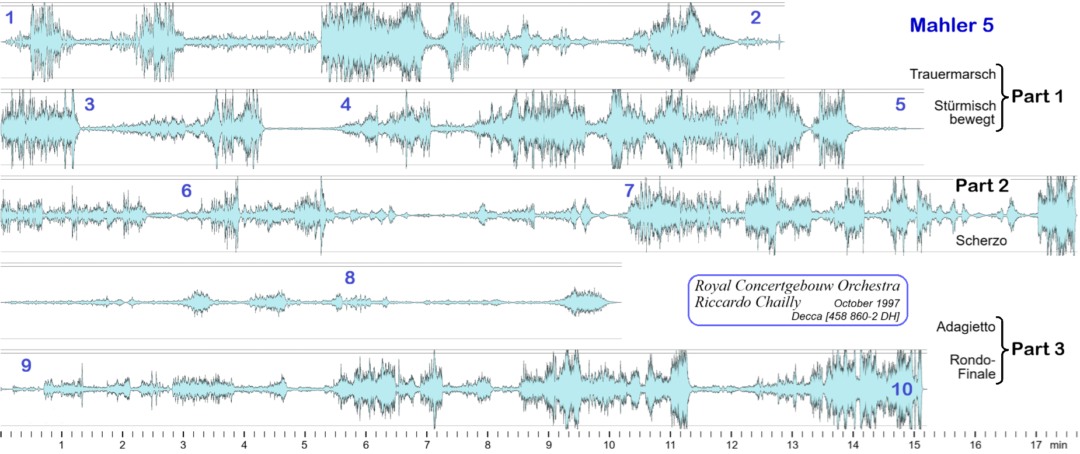
The symphony consists of three Parts built of five movements: (1+2) ; (3) ; (4+5) as shown in Figure 2. The middle movement “Scherzo” (Part 2) forms the thematic core, which Mahler composed first in summer 1901. He continued with the first and second movements (Part 1) “Trauermarsch” and “Stürmisch bewegt” the same summer. It seems that the “Adagietto” was probably composed in December and “Rondo-Finale” during the following summer of 1902.
–
–
The emotional journey through M5 follows a plot:
from ‘mourning and grief amid storm’ in Part 1 to ‘love and joy’ in Part 3 through ‘learning to dance with the Fate’ in Part 2.
Actually, ‘from gloom to joy’ or ‘from struggle to victory’ are not rare plots for romantic symphonies, but M5 is generally paired with Beethoven’s fifth (B5) as the prime examples of ‘Fate Symphonies’. The opening of B5 is among the best recognized moments in concert music. Beethoven ordered the orchestra to apply its power for a warning. The “Fate is knocking” on a common door of the whole humanity. I acknowledge that my example is not among the most dramatic recordings of B5 in sound, but I find it appropriate to begin with a youth orchestra gathered from the middle east region:
18 first seconds of B5 played by the West-Eastern Divan Orchestra, Daniel Barenboim, “Live in Ramallah” 2005.
Referring to B5, Mahler applied the power of eight double basses for opening of the M2. The music is different, but the reference is obvious:
15 first seconds of M2 played by the Philharmonia Orchestra, Benjamin Zander, Watford Colosseum 2012.
–
First movement – Fate knocking on the doors
For M5 Mahler adopts the B5 rhythmic motif as such but knocks on a private door [example 1]. In contrast to B5, Fate is not threatening the ‘mankind’, but each human being. A solo trumpet fits here, because we are invited to heavy music orchestrated to remind us of military brass bands and the miseries of war:
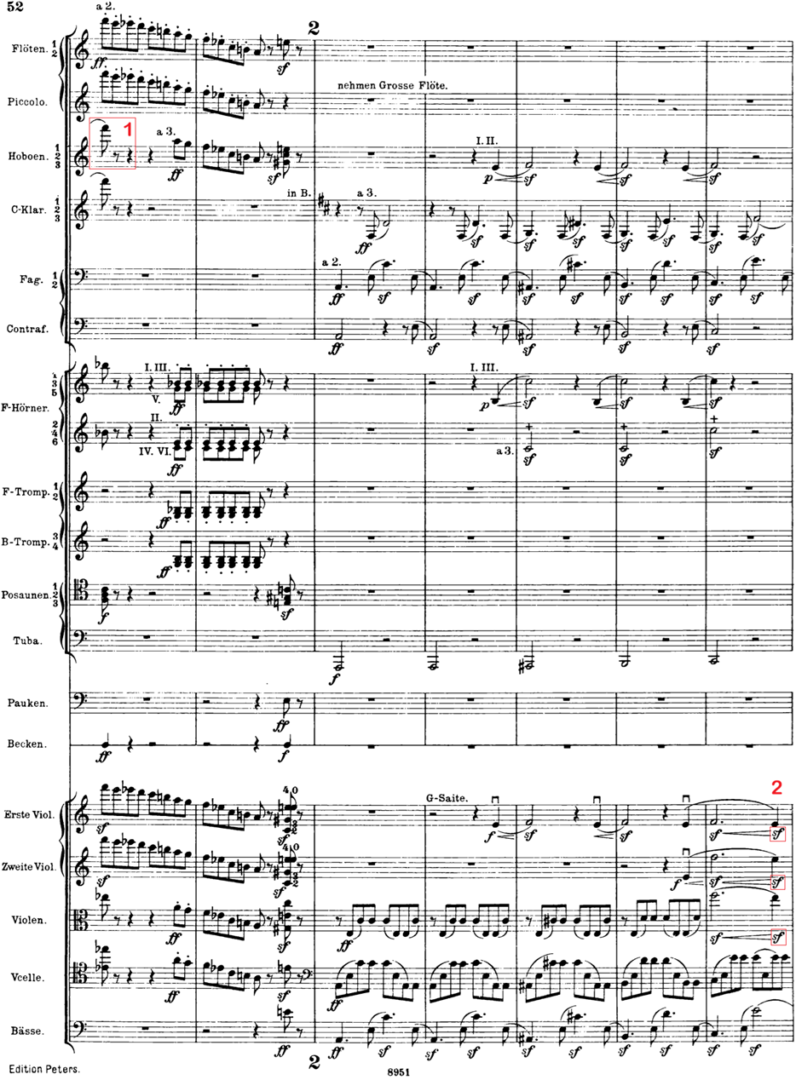
25 first seconds of M5 by Concertgebouw Orchestra, Riccardo Chailly, Amsterdam 1997 [1] in Figure 2.
–
The trumpeter is put in middle of the stage. He/she stays there through the whole movement repeatedly alerting of the approaching Fate, also as a lone trumpeter boy dragging himself through a destroyed battlefield. Fragile woodwind voices (oboes clarinets and flutes) are given opportunity to express their sorrows, but the brass (horns, trombones, tubas) takes over and gradually drowns the gentler voices under waves of metallic power. The broad percussion section remains busy for most of the time. However, the point of view is that of ordinary people who’s daily life – even joy and hope – also belong to the drama. The human points of view are typically heard from the woodwind section. This is no “Eroica” (B3, Marcia funebre. Adagio assai). Nothing noble in this funeral march, just brutal death without mercy or comfort.
Where does the trumpeter lead us and what she/he has to say there? In the end, the defiant call which opened the movement returns modestly and muffled, puts on a damper and fades “con sordino” into silence at a grave yard. A softer, but more resilient and better enduring flute takes over and plays the last beat. The coffin has reached the bottom of the grave pit and the strings cap the movement. A nice visual capture of this sequence [2] can be found in the YLE Areena at:
[RSO – Ryan Wigglesworth 2019].
Finnish Radio Symphony Orchestra, Ryan Wigglesworth, Musiikkitalo, Helsinki 2019;
Jonas Silinskas plays the solo Trumpet and Kaisa Kortelainen the flute
Timo compared several M5 recordings and found notably different manners in playing this sequence [2], actually the last note. A closer look revealed that Mahler had edited this point when preparing for the premier (or after). We suggest that this may have rooted two different traditions of capping this “Trauermarsch”. The study is explained on a separate page:  .
.
I referred above to ‘miseries of war’ and wrote a full chapter on that, but removed it from here. If interested in links between M5 Part 1 and songs composed during the same summer – or on ‘Les Misères et Les Malheurs de la Guerre’ – the chapter will be soon here: .
–
Second movement – Stürmisch bewegt
If the first movement ended in silence at a graveyard, a complete change of scenery happened during the short pause. The second movement begins in full action – with a rising storm. The first minute could be easily used in a movie filmed on board of an old sailing ship at an open sea. A storm raises abruptly, sea is getting wild and everybody on board is busy coping with the storm. This scene ends short. The ‘storm’ calms, gradually but within seconds. Soon we notice that we are witnessing a strange kind of procession [3]. It is worth of a closer look, in particular together with the developed and condensed version soon after [4].
Some unknown birds of various sizes and voices appear chirping strangely after the storm [3]. The strings begin a gentle mourning march. The strings begin a gentle mourning march and the wind instruments join, but the birds continue their cackling and giggling as if making sarcastic and mocking comments about those participating in the funeral march. The upper part of the score page in Figure 3 looks like a cloud of birds consisting of oboes, clarinets, bassoons, contrabassoon and horns. The tuba and solo violin join in commenting. This evolving section leads to noisy takeover by brass. The resulting turmoil ends when the cellos begin a long passage of gentle mourning. Other strings and winds join later.
–
–
Below are the audio clips for related examples 3-4. The first clip [3] introduces the mockers in a longer time (38 s.):
[3] Mocking ‘birds’ follow the mourning march led by strings. Philharmonia Orchestra, Benjamin Zander, 2000
The repeated scene [4] begins with 10 seconds of gentle mourning for tuning before 15 seconds of marching led by the horns. The repeated procession amid mockers in [4] is squeezed and developed more complex with parallel mocking comments in a shorter time. The resulting music is a good example of Mahler’s use of the orchestra as a large group of soloists and his innovation on ‘emotional counterpoint’. Exceptional in this case is the amount and variety of emotions expressed simultaneously:
[4] A developed version of the march led by horns. The mocking comments are packed more in parallel.
I’m sure that a normal listener cannot distinguish all these levels from an audio recording, and the directors of audiovisual recordings find it better not to try to show who is playing what (RSO in YLE Areena 2015, 2019,2024). We can try to see and hear them in a concert. In our case, a score arranged for chamber orchestra will be played and minor changes in instrumentation are expected, but this sequence of ‘emotional polyphony’ may become even easier to follow in the Tapiola concert. If you aim to focus on this challenge, wake up when the horns prepare to play after the strings have continued quiet mourning for about a minute.
Fortunately, Benjamin Zander with the Philharmonia Orchestra have provided a supplement on their M5 CD [TELARC 2CD-80569]. The different roles of the mourners an commentators are split in six groups, played and recorded separately:
–
[4] A funeral march amid mockers split six groups. Audio clips from [TELARC 2CD-80569].
The volume of audio examples [3-4] above are amplified by factor of 4 because they are from low volume sections. The almost silent example [5] is amplified by factor of 5. Various amplification factors are applied also in later examples.
The rest of the movement is spent in almost continuously changing moods, up and down, back and forth. There are moments of warm beauty and optimism, a lot of busy aspiration towards light … and a hit back. The strings and woodwinds often try their best expressing human point of view, but the brass and percussion are not sharing the same goals. There is still a ‘Beethovenian’ minute before the last storm, just as if the orchestra were preparing together for a victorious finale. The brass even makes a short, but loud visit to the bright tones of the Finale (from D-minor to D-major). But they end in wild turmoil, which suddenly subsides into a quiet reminder that we are still in the Part 1 of the symphony. Similar to the end of “Trauermarsch”, the trumpeter puts the damper on but has now even less to say. The cacklers and gigglers provide their final distant remarks. This time the movement is silent capped by a drum together with harp, cellos and basses:
[5] The final fading remarks of cacklers and gigglers, movement 2 gradually drifting to silence. Philharmonia Orchestra, Benjamin Zander, 2000 [TELARC 2CD-80569].
–
Part 2, the “Scherzo”
This is a long waltz in Vienna. Not a “Wiener Waltz” to played in the annual worldwide broadcast of New Year’s Concert at the Golden Hall in the Musikverein. Neither a pure “Ländler” danced in the countryside and in other Mahler’s symphonies. The waltz get twisted in many times and ways, but when it is played in a delicate manner, we are in a Viennese coffee house where a small chamber orchestra is playing.
[6] A good days waltz in Vienna. Chicago Symphony Orchestra, Claudio Abbado, 1980.
In other words, the Scherzo happens in Vienna, where Mahler had studied in youth and returned four years ago for a dream job. As director of the Hofoper, he had the best possible powers to improve the state-of-the-art in performing masterpieces of Wagner, Mozart and others. Vienna was home for artists, scientists and intellectuals, but also for conservatism and active antisemitism. Although Mahler had ‘converted’ to Catholicism, he faced pressure due to his Jewish roots, as many of his friends did even more. His post in the Hofoper lasted for ten years because having been appointed by the Kaiser Franz Josef, nobody else could release him of the duties.
We can assume that Mahler loved Vienna, but hated some elements in there. This is what the “Scherzo” tells us – from one point of view. Our journey through M5 has passed Part 1 ‘mourning and grief amid storm’ and now we are ‘learning to dance with the Fate’ in 3/4 time:
[7] Dancing with the Fate in Vienna. Chicago Symphony Orchestra, Claudio Abbado, 1980.
There are other points of view. Many conductors are fascinated of the new style of music and composing Mahler introduced here. I do not have competence for going into that. Instead I copy parts of Mahler’s letter to his wife Alma who remained in Vienna when the M5 was first performed in Cologne, 18 October 1904. The letter makes it clear that Mahler was concerned about getting his new style of composing understood by the conductors and received by the audiences. He saw the scherzo particularly challenging and expressed his ‘signature idea’ according to which his music could be better received 50 years posthumously.
Dom Hotel, Cologne, 14 October 1904
Dearest Almschi,
… Well, today was the first rehearsal. Everything went tolerably well. That scherzo is an accursed movement! It will have a long tale to woe! For the next fifty years conductors will take it too fast and make nonsense of it. And audiences – heavens! – how should they react to this chaos, which is constantly giving birth to new worlds and promptly destroying them again? What should they make of these primeval noises, this rushing, roaring, raging sea, these dancing stars, these ebbing, shimmering, gleaming waves?
… Would that I could perform my symphonies for the first time fifty years after my death!
(translated by Antony Beaumont)
[Ein Glück ohne Ruh’- Die Briefe Gustav Mahlers an Alma. Ed. La Grange, Weiss, BTB 1997, 576 p.]
–
Part 3, “Adagietto” and “Rondo-Finale”
We started linking the ‘Mengelberg story’ with an overnight transition of a bachelor into a groom and husband. If we accept the story and hypothesis of the chronology, it would result that “Adagietto” was composed by the groom and “Rondo-Finale” by the husband. I agree that it would have been an extreme exception to compose the Adagietto during the season in the opera in November/December, but even miracles happen sometimes.
- The previous summer had been extremely productive is terms of written music. Mahler’s creativity was at its peak.
- If motivation helps in fight against the clock, November 1901 could also have been a very productive month.
- The meeting with Alma caused sleepless nights. Could they be have been used for composing?
- This would mean that the summer 1902 was less productive, but there were two good reasons for that:
Alma Mahler and Maria Anna Mahler (to be born November 3rd).
–
Adagietto for strings and harp
This movement gives a good and rare example on Mahler’s partial use of the maximum sized orchestra according to need. The Adagietto is written as a whole for string sections accompanied by the harp. No brass or winds, no percussion. They are finally given a long break they deserve. And we are given a most beautiful song.
As a tempo marking, ‘adagietto’ would be a diminutive form of ‘adagio’ and mean: “rather slowly, not as slow as adagio”, but Mahler marked it to be played very slowly. However, numerous verbal instructions reveal that an atom clock beat is not needed and the tempo shall be varied frequently. There are also qualitative remarks like ‘dragging’, ‘warmly’, ‘hesitantly’. As seen in Figure 1, the tempo instructions begin with: “Sehr langsam.”, “molto rit.”, “molto adagio” and continue during the 30 first bars as follows:
bar remarks
1-3 very slow, significantly reduce tempo, very slowly
10 not dragging
20 reduce tempo
22 extremely slow again
27 somewhat dragging
29 flowing
30 holding back
The timings of Adagietto in recorded performances varies in ratio of 1 to 2, between 7 and 15 minutes. Faster tempo normally correlates with more positive mood and slow tempos with deeply solemn moods, but time is not the only parameter.
–
Adagietto as funeral music
The musicians and audiences have found contrasting emotions in the “Adagietto”. The inbuilt ambiguity begins already with the name and tempo markings, and the strong emotions embedded between the notes can be expressed with notable variety, even for a funeral or wedding.
The Adagietto begins gently and the early part suits seemingly well for funeral use. Leonard Bernstein and New York Philharmonic did a reference performance in the St. Patrick’s Cathedral, New York City, on 8 June 8th 1968. Adagietto in funeral ceremony of the assassinated senator and presidential candidate Robert Francis Kennedy was noticed and may have notably affected its interpretation and reception. Bernstein conducted slow but cut it short, playing only for 2:41:
[June 8th 1968 in the St. Patrick’s Cathedral, N.Y].
B.t.w.1: RFK and JFK are often mixed and claimed that Adagietto would have been played in the funeral ceremony of Robert’s elder brother, president John Fitzgerald Kennedy, who was in reality honored in 1963 by playing Mahler’s Second Symphony. First by M2 as a whole, N.Y Philharmonic & Bernstein live TV broadcasted for national mourning after the assassination, and then the “Resurrection” part in the ceremony.
B.t.w.2: Adagietto was naturally played also in the ceremony for Bernstein, as a recording conducted by himself. According to his request, the a ‘pocket score’ of M5 was put on his heart in the coffin.
It seems that Mahler’s music and Adagietto in particular was dear to Leonard Bernstein. Indeed, he played a notable role in introducing and promoting Mahler’s music in the USA (and also in Europe). Actually, Willem Mengelberg → Nadia Boulanger → Aaron Copland → Leonard Bernstein formed an influential chain for preservation of Mahler’s music for 50 years, while it was banned or little played in Europe. I have explained this chain reaction on another page: .
–
Adagietto as a wordless love song
Tapiola Sinfonietta’s M5 concert was given a subtitle “Love song”. This gives us a reason to expect that the Adagietto will be played in reasonable time with some rhythmic freedom. Good tempos and breathing rubato evoke bright emotions and may tune the Adagietto to a lovely song. It is aimed to be impassioned emotional, but not sugary sentimental. There is no hero singing a serenade under the window of his beloved.The Adagietto is composed of sustained, without a clear driving pulse flowing lines in the strings, often described to create a sense of ecstasy, timelessness, levitation or ‘loss of gravity’.
But let’s keep in mind that this is belongs to a Mahler’s symphony, where “everything” shall be embraced. The anguish and mourning in Part 1 should not be all forgotten or wiped away. The Adagietto is not comparable to the six layer ‘emotional polyphony’ explored in the 2nd movement, example [4], but no doubt, different layers of emotions are embedded also in the Adagietto. Ultimately, it is up to us whether we feel sorrow, joy, or something else when listening to it.
When composing, Mahler was continuously referring to his previous, and seemingly, sometimes even coming works. A good example is the ‘predictive reference’ in M4 to the opening trumpet in this M5. As in scientific writing, historic masters and masterpieces are preferred subjects for referring. At least Beethoven, Wagner and Bach are referred in M5. The Adagietto has much in common with the song “Ich bin der Welt abhanden gekommen”, which Mahler composed in parallel with Parts 1-2 of M5 during summer 1901. The song is part of the collection “Rückert Lieder” based on poems by Friedrich Rückert and is among the most famous applications of the “Ewigkeit” motif. Variations on this Mahler’s signature motif appear regularly in his music, with or without words, typically alluding to eternal questions or representing an eternally lasting moment. The “Ewigkeit” motif is indirectly applied in the timelessness of Adagietto, where slow, descending, and sighing melodic lines are structurally related to this motif. The similarities between the song and Adagietto are not limited to the application of this motif. In both, the orchestration focuses on the harp and strings. I will refrain from going into more depth here, but continue discussion on “Ich bin …” in another posting: .
When considering the assumed “Love letter” function, the “Ewigkeit” theme probably didn’t impress Alma, who knew Mahler as director and conductor, not as composer. Actually it seems that she was not a particular fan for his music, but if Alma recognized the original reference, it may have played a role here. Mahler had adopted the “Ewigkeit” as a reference to an important scene in Wagner’s opera “Siegfried”, where Brünnhilde, daughter of the king of gods (Votan) abandons the world of the gods and sings in love with Siegfried to him: “Ewig war ich, ewig bin ich, ewig in süß sehnender Wonne, doch ewig zu deinem Heil!” (Eternally I was, eternally I am, eternally in sweet yearning bliss, yet eternally for your salvation!):
64 seconds from Bayreuth Festival 1992. Anne Evans singing, Daniel Barenboim conducting. The “Ewigkeit” at 26-40 seconds.
–

–
Another Wagner reference has also been suggested for the Adagietto;
the “Glance” motif in Wagner’s opera “Tristan and Isolde”:
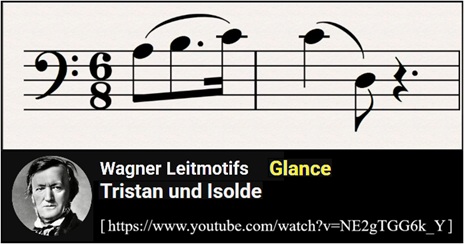
In “Tristan and Isolde” the “Glance” motif refers to to an events turning glance between Tristan and Isolde. The momentary eye-to-eye glance made them drawn to each other and later made them inseparable. So, both of these melodic Wagner references refer to ‘begin of eternal love in divine scales’, and would thus fit perfectly to a “Love letter”. Alma knew the sources and had capacity for recognizing this kind of references. She had studied music, spent a lot of time in the opera and was familiar with Wagner’s operas. Furthermore, she adored Mahler as the ‘superhuman’ director of the Opera. Just imagine Wagner’s Ring and Tristan put together: a daughter of king of the painters (Schindler) falling in love with a ‘man of the future’ from Bohemia (Mahler) after a “Glance” at the Zuckerkandl’s. I’m sorry about this, it just happened to come to my mind while wondering plausibility of the ‘Mengelberg story’.
–
Adagietto in Amsterdam
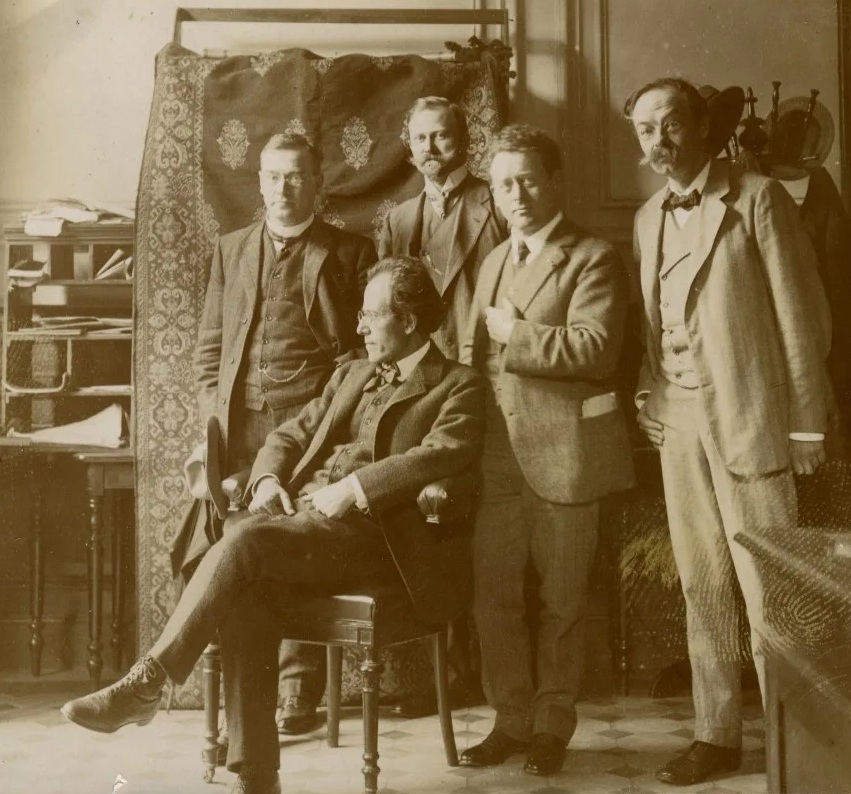
Coming back to Amsterdam some 120 years ago. Could somebody there confirm this story? Three potential candidates can be seen in a group photo (Figure 6) where Willem Mengelberg stands besides Mahler. Concertgebouw’s accountant Hendrik Freijer is our least probable witness. The second conductor Cornelis Dopper on left could have heard the story, but his tenure as Mengelberg’s assistant began 1908 when M5 was already in Mengelberg repertoire as instructed by Mahler in 1906. Alphons Diepenbock on right remains our best candidate witness. He was a doctor in classical studies and self-learned composer & conductor with whom Mahler found common interests in literature and philosophy (Goethe, Wagner, …).
–
–
When visiting Amsterdam Mahler was met with friendship and hospitality. Mengelberg’s met him already at the train station and insisted to host him in their home. A warm and lasting personal relationship grew also with Alphons and Elisabeth Diepenbock, who spent much time together with Mahler. In March 1906 the Concertgebouw Orchestra performed M5 seven times, the first performance in Amsterdam March 8th was conducted by Mahler and six follow-ups by Mengelberg. Diepenbock’s followed Mahler’s rehearsals and at least all three concerts in Amsterdam (other concerts were in Rotterdam, The Hague, Arnhem and Haarlem). 23rd of March 1906 Elisabeth Diepenbock wrote in her diary:
‘Yesterday and the day before again Mahler’s Symphony (the 5th). … we were also deeply moved by the Adagietto. Fons thinks it is almost too tender, especially at first, he understands it as a love song; …’
This diary note referred to concerts conducted by Mengelberg, but just two weeks after Mahler’s and the time spent together. So, did Alphons Diepenbock get the ‘love song’ idea from Mahler or Mengelberg? Or just by listening the Concertgebouw Orchestra conducted by Mahler and Mengelberg? I find here some potential support for the ‘Mengelberg story’. Thanks belong to Mahlerites in the Netherlands and Donald Mitchell [footnote 97 on page 332 in D. Mitchell, ‘Discovering Mahler’, 2007].
It’s time to call Willem Mengelberg to testify himself for the story. Fortunately, the Concertgebouw Orchestra under his baton made an electrical quality recording of Adagietto in 1926, and a recent restoration project has been able to provide a good-sounding copy of the recording 100 years ago in the Concertgebouw large hall [Paul Howard, Yucaipa Studio; Private Reserve, January, 2026]. Mengelberg conducted the Adagietto in 7 minutes and 4 seconds, much faster than most of the conductors, and in much different style as well. The difference to the Bernstein’s ‘funeral style’ could hardly be larger:
[1926 in the Concertgebouw, Amsterdam].
Concertgebouw Orchestra, Willem Mengelberg, Concertgebouw large hall, Amsterdam, 1926
[June 8th 1968, Robert Kennedy funeral].
New York Philharmonic, Leonard Bernstein, St. Patrick’s Cathedral, New York, 1968
–
Adagietto as an adagietto
Timings between 9 to 11 minutes are typical for Adagietto recordings. If less than 8 or more than 12 minutes are be considered rarities, (7:04) for the Mengelberg & Concertgebouw in 1926 is extremely fast. Bruno Walter conducted almost as fast, (8:10) with Vienna Philharmonic in 1938 and (7:37) with New York Philharmonic in 1947. As Walter and Mengelberg heard Mahler conducting M5, discussed with him and highly respected Mahler’s works, it is a fair assumption that their approach for a ‘wordless song’ is in line with the composers aims. Mahler’s timings during the first performance are not known, in Berlin 1905 it was reported 9 minutes for the Adagietto, but only 7 minutes in St. Petersburg 1907. All three used tempos which would have allowed singing, if there were words to sing.
A link to the Mengelberg’s Adagietto was given above. Also Walter’s versions can be found in the net (and below). I do not have Mengelberg’s Adagietto on CD, but comparable Walter’s versions of a short middle part [example 8] are given below. A 1987 recording of Leonard Bernstein conducting Wiener Philharmoniker is included. Improved quality of sound helps revealing the beauty, but for a large portion of the time (11:08) the mood approaches a lingering elegy rather than joy. The fourth sample brings us back to the Concertgebouw, a safe haven for Mahler’s music in Europe between the world wars. Riccardo Chailly had access to the scores that were used when Mahler and Mengelberg conducted “Mahler’s second home orchestra” at the Concertgebouw. He cherishes the heritage of the venue and Mahler with a broad palette and notably lower pace than Mengelberg (also benefiting of modern high fidelity recording).
–
[8] Bruno Walter, Vienna Philharmonia Orchestra, 1938.
[8] Bruno Walter, New York Philharmonic-Symphony Orchestra, 1947.
[8] Leonard Bernstein, Wiener Philharmoniker, 1987.
[8] Riccardo Chailly, Concertgebouw Orchestra, 1997
–
Last but not the least, let’s not forget Claudio Abbado. He contributed to the Mahler heritage in many ways and on many continents, also with the Chicago Symphony Orchestra. Their M5 recording in 1980 spent a long gentle time with the Adagietto (11:54). But in 2004 he made it in (8:20) part of his digestive system removed due to stomach cancer and, again, with a new orchestra founded (the Lucerne Festival Orchestra). There is a YouTube video of the whole M5, but the following link hits directly to the Adagietto:
[Lucerne Festival Orchestra – Claudio Abbado 2004]. (8:20)
–
Note also M5 by RSO in Areena; here are direct links to Adagietto:
[Adagietto – RSO & Nicholas Collon 2024] ; (9:10)
[Adagietto – RSO & Ryan Wigglesworth 2019] ; (9:20)
[Adagietto – RSO & Hannu Lintu 2015] ; (10:40)
–
Conclusionetto
I suggest accepting the Mengelberg’s point of view either as a fact or as fiction that matches with the result, music in form of a touching and most beautiful song – without words. The style of writing in the ‘TALE’ and ‘POEM’ in Figure 1 look somewhat different, perhaps written in different times. However, there is a third note at lower margin of the page. It is written in a style resembling the ‘TALE’ and the message is fully compatible:
–

–
Hopefully correct reading and translation gives:
“N.B. Wenn Musik eine Sprache ist / so ist sie es hier — er sagt ihr ALLES in “Tönen” in “Klängen” in Musik”
‘N.B. If music is a language, then it is here — he tells her EVERYTHING in “tones”, in “sounds”, in music’
Figure 1 contained this ‘TALE’ :
‘N.B. This Adagietto was Gustav Mahler’s declaration of love to Alma! Instead of a letter, he sent her this manuscript, not a word added. She had understood it and wrote him: He should come !!! (both of them have told this to me! W.M.’
In conclusion, I buy these parts of the ‘Mengelberg story’ and assume that being inspired by the story, Mengelberg fitted himself a ‘POEM’ to the violin melody. There are a lot of blue and red colored markings, which probably date from March 1906, when he followed Mahler’s rehearsals and prepared for conducting the seven follow-up concerts soon after.
Several musicologists used to hearing Adagietto in slow solemn versions criticize Mengelberg of exaggerating the passion. I think he had a right to do so. Also Bernstein had his right to play another kind of Adagietto as a separate piece, by which he affected or biased (?) the legacy of Adagietto, certainly more than Mengelberg did.
If still interested, I suggest listening to the 1949 New York recording with Mahler’s closest protege Bruno Walter or to the Mahler’s heritage nurturing ‘home orchestra’ beautifully conducted by Riccardo Chailly in 1997:
Bruno Walter & N.Y. Philharmonic
Concertgebouw with Riccardo Chailly .
–
Fifth movement – the “Rondo-Finale”
The Adagietto served as an intermediate step along our route from mourning and grief to ultimate joy. Having learned to live and dance with the Fate, we found a peaceful nest in the unhurried Adagietto. It acted as a necessary prelude for this Rondo, which could not have followed the Scherzo directly. In the previous M4 the final movement addressed joy in form of a hungry child’s vision of heaven (with plenty of food). This time Mahler aims for a festival of true happiness on earth – or actually in a land of ‘absolute’ music, shared with Bach and Haydn. If discontinuity dominated in the Part 1, here the music flows with continuous counterpoint.
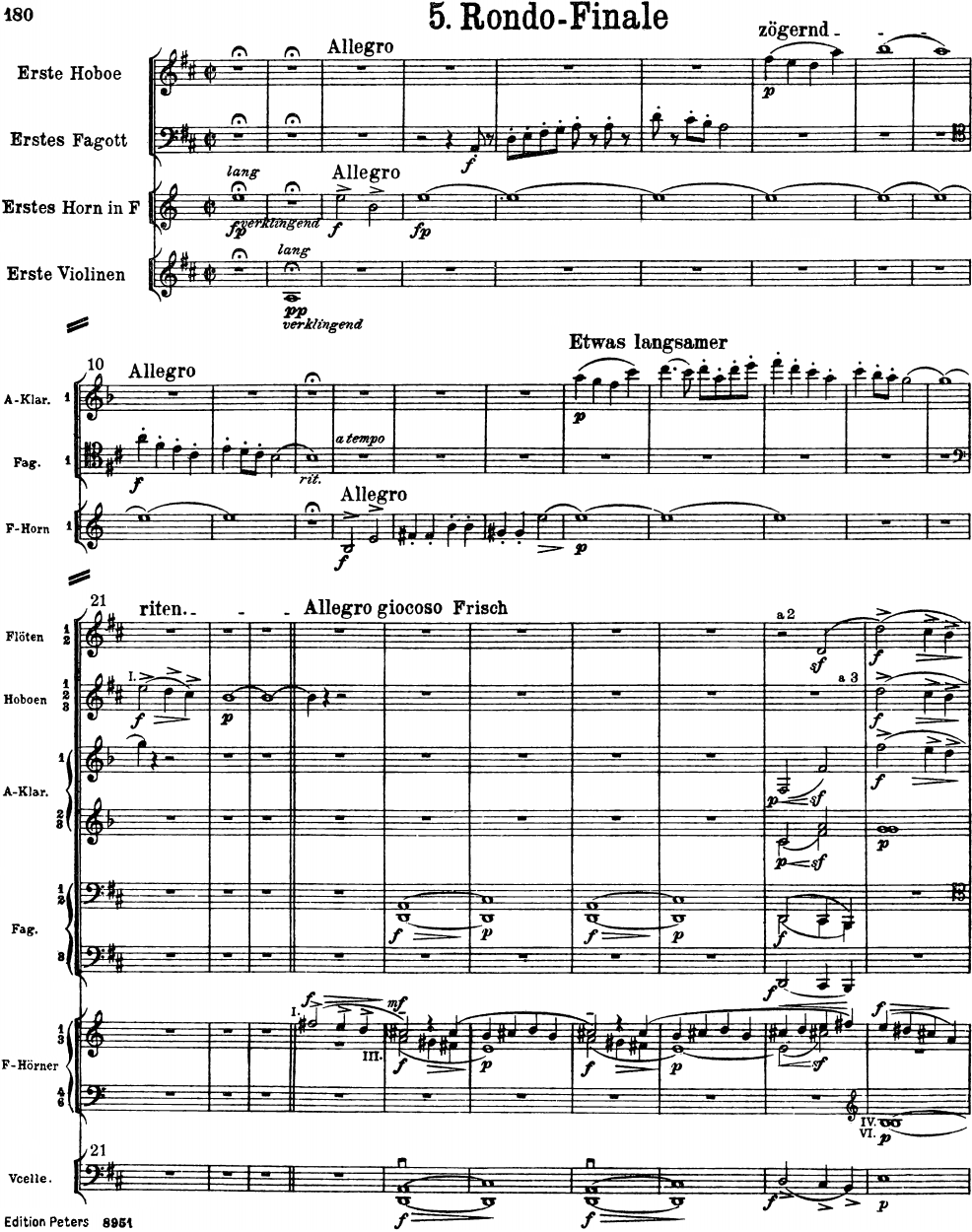
The Adagietto had only 103 bars, but Rondo-Finale has 791. With commonly used timings this gives average tempos round 40 beats per minute for Adagietto and ≥200 for the Rondo-Finale (on 4/4 scale). The two firsts bars for a horn followed by first violins are still marked ‘long, fading away’ before an abrupt speed-up. The horn begins a solo and invites the bassoon, a ‘hesitant’ oboe and the clarinet to join in cheerful ‘Allegro’. After 20 bars the winds and horns join in groups, while the strings continue their break after the Adagietto. The cellos return first on the playground, then the basses (bar 38). The rest of strings join at bars 68-72 and pretty soon take over the lead. The winds and horns continue busy most of the time, but the brass and percussion get busy only later on. The opening sequence is shown in Figure 8 and played in the following example [9]:
[9] 48 first seconds of Rondo-Finale (bars 1-27 in Fig.8). Riccardo Chailly, Concertgebouw Orchestra, 1997.
–
It is of course even better to open the YLE Areena at the relevant point to see and hear who is playing what:
[Rondo-Finale – RSO & Nicholas Collon 2024]
–
Figure 8 reveals how an encouragement ‘Allegro’ is repeated four times on the first score page of the Rondo-Finale. Riccardo Chailly has noted that he has not seen so dense repeated Allegro notes anywhere else. The fourth is complemented to “Allegro giogoso Frisch” (cheerful, quickly and brightly in a happy mood, fresh) and provides a short description of the movement as a whole.
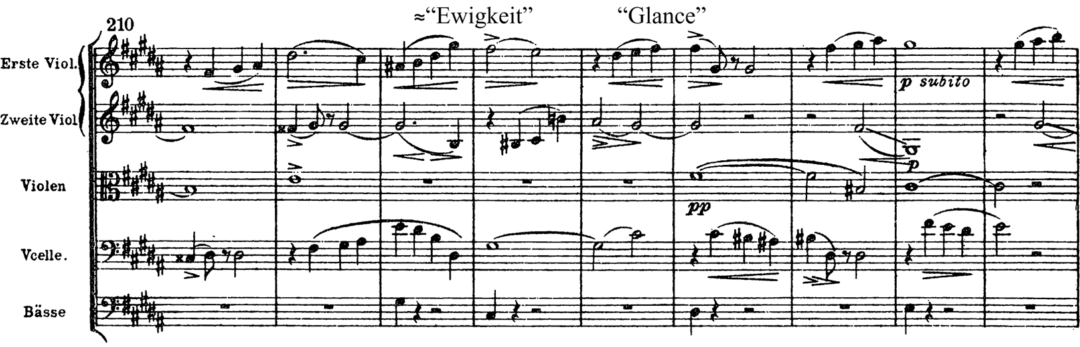
There are references to previous parts, but the mourning in Part 1 is not repeated and ‘emotional polyphony’ is left behind. The connections to Adagietto are broader, making it clear that Adagietto and Rondo-Finale belong together as elements of the Part 3. The slow melodies of Adagietto are replayed and varied in so fast tempo that they are difficult to recognize. Figure 9 shows an example of a passage which is referring to the Adagietto. There are better matches for the “Ewigkeit” motif, but I picked this one with the neighboring “Glance” motif. Both were applied in the Adagietto, as explained above.
–
Mahler was know of mastering use of black humor and and irony. Symposia have been organized and books written on irony in his music, but not on irony in this Rondo-Finale. This time we get a demonstration how joyful bright humor can be used even to cap the whole symphony. The orchestra keeps on climbing towards a conventional closure with victorious brass, but suddenly the plan is changed as if happy children had entered the stage running back and forth, singing and dancing of joy. Therefore, another youth orchestra is a natural choice for our final example: